Abstract Column properties such as the chemical and thermal stability, reproducibility and repeatability of RPLC phases are determined to a great extent by their surface chemistry. Since these are important to the selection of a column, understanding the physical and chemical surface properties is extremely important.
LevelAdvanced
The properties of HPLC stationary phases can be distinguished into two groups:
- Physical properties determine the kinetic performance of a column packed with a given stationary phase to a great extent. The most
 important physical properties of a packing material include: particle size and shape, porosity, pore size, surface area and mechanical strength. In general, these parameters are indicated as the so-called bulk properties of a stationary phase. Since they determine the efficiency, the average particle
  size and the particle size distribution of a stationary phase are among the most important of the physical properties. Stationary phases can be manufactured as irregularly and spherically shaped particles.
 - The chemical properties of the surface, which determine the tripartite chromatographic interactions between
 analytes, eluent and the stationary phase.
distributions of approximately 25 % around the mean nominal value, providing high efficiency columns. The reproducibility of the physical properties, especially particle and pore size of the phase is even more important in obtaining reliable and reproducible results. An example of modern batch to batch reproducibility is presented in the figure below. In this graph, it can be seen that different batches of the well known Bondapack C-18 stationary phase show virtually identical accumulated volume versus particle size curves. Particle-size distribution of several batches of Bondapack C18.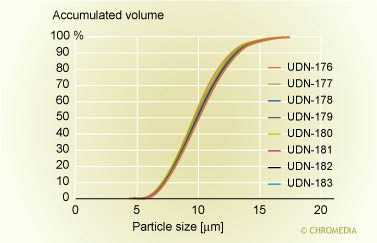 Waters Corporation
The smaller the average particle size packed in a column, the higher the efficiency per unit column length will be. The acceptable pressure drop across the column does place an effective lower limit on particle size, however, and is dictated by the available HPLC equipment, among other factors.
Currently, there is a strong drive to reduce analysis times which can be achieved through several different approaches. The use of higher column pressures, higher eluent and column temperatures, and columns of greater permeability, e.g. monolithic columns, can increase separation speed. This explains the recent interest in short HPLC columns (30 and 50 mm columns are becoming common) packed with particles of or below 2 μm in diameter. Like their larger counterparts, these new particles must be extremely monodisperse, with a narrow distribution of diameters around the nominal value in order to maximize column efficiency.
In order to avoid unwanted size exclusion effects in HPLC, the pore size of a stationary phase must be selected carefully and should be compatible with the dimensions of the analyte molecules. If the pore diameter of a packing  material is smaller than 10 times the analyte’s diameter, restricted diffusion may interfere with other retention mechanisms.
A large number of phases with well defined pores ranging from 50 to 4000 ångström are now available.
- For the separation of small molecules, a pore size of about 100 ångström is normally used,
- A pore size of 300 Ängströms or larger is more adequate for the separation of large biomolecules.
- Since they give rise to unwanted size exclusion and irreproducible adsorption effects, microporous volume should be minimized.
The surface area of a stationary phase is approximately inversely proportional to its particle size. Regardless of particle size, the contribution of the external surface of porous particles to the total surface area is nearly negligible in comparison to the contribution from the inner surface area of these particles.
In chromatographic separations, there must be sufficient surface area:
- In order to facilitate the retentive interactions between the stationary phase and the analytes.
- To allow the injection of a detectable amount of sample on the column.
Thus, the sample mass as well as volume loadabilities of porous, pellicular and non -porous packings are substantially different. Presently, porous stationary phases are available with surface areas ranging from 10 to 500 or more m2 per gram of packing material. The following tables present the morphologies and compositions of a variety of commercial RPLC stationary phases.
List of column manufacturers, column dimensions and abbreviations
| Column | Manufacturer | Abbr. | No. |
| Zorbax RX-C18 | Agilent | RX | 1 |
| Polygosil-60-5-C18 | Macherey-NagelGmbH & Co., Düren, Germany | Poly | 2 |
| Hypersil HyPURITY C18 | Shandon HPLC, Runcorn, UK | HyPUR | 3 |
| Hypersil ODS | Shandon HPLC, Runcorn, UK | Hyper | 4 |
| Symmetry C18 | Waters Assoc., Milford, MA, USA | Sym18 | 5 |
| Purospher RP-18 e | Merck, Darmstadt, Germany | Puro | 6 |
| Kromasil KR100-5C18 | Eka Nobel, Bohus, Sweden | Krom | 7 |
| Alltima C18 5U | Alltech Assoc.,Deerfield, IL, USA | All | 8 |
| TSKgel OD-2PW | TosoHaas GmbH, Stuttgart, Germany | TPW | 9 |
| TSKgel ODS-80TS | TosoHaas GmbH, Stuttgart, Germany | TTS | 10 |
| Eclipse XDB-C18 | Agilent | XC18 | 11 |
| Nucleosil 100-5 C18 HD | Macherey-NagelGmbH & Co., Düren, Germany | NuC18 | 12 |
| Column | Manufacturer | Abbr. | No. |
| Eclipse XDB-C8 | Agilent | XC8 | 13 |
| SymmetryShield RP8 | Waters Assoc., Milford, MA, USA | Sym8 | 14 |
| LiChrospher RP-Select B | Merck, Darmstadt, Germany | SelB | 15 |
| Aluspher RP-Select B | Merck, Darmstadt, Germany | Alu | 16 |
| Nucleosil 100-5 C8 | Macherey-Nagel GmbH & Co., Düren, Germany | NuC8 | 17 |
| Nova-Pak C8 | Waters Assoc., Milford, MA, USA | Nova | 18 |
List of tested C-18 columns and their physico-chemical properties
| Column | RX | XC18 | Puro | Hyper | HyPUR | Sym18 | Poly | NuC18 | Krom | All | TPW | TTS |
| Particle size (mm) | 5.2 | 5 | 5.8 | 4.5-5 | 4.5 | 4.95 | 5.2 | 5.4 | 6.2 | 6.18 | 5 | 5 |
| Pore size | 80 | 80 | 120 | 120 | 180 | 93 | x | 115 | x | 111.9 | 125 | 80 |
| Pore volume (ml/g) | 0.45 | 0.4 | 1.0 | 0.6 | 1.0 | 0.66 | 0.85 | 1.15 | 0.91 | 0.88 | x | x |
| Surface area (m2/g) | 180 | 180 | 350 | 170 | 200 | 332 | 350 | 340 | 349 | 316 | x | 198 |
| Carbon loading (%) | 12 | 10.3 | 18 | 9.5 | 13 | 19.4 | x | 21.0 | 21.4 | 16.22 | x | 15 |
| Surface coverage (mmol/m2) | 3.3 | 3.5 | 3.2 | x | x | 3.21 | x | 3.60 | 3.45 | x | x | x |
| Bulk density (g/ml) | 1.0 | 1.0 | 0.4 | x | x | x | x | 0.36 | x | x | ca.1 | x |
| Endcapping | no | double | yes | yes | yes | x | x | yes | yes | double | no | yes |
| Silica | RX-sil | RX-sil |
|
|
|
|
|
| poly- |
| meth- | high purity |
| Column | XC8 | SelB | Alu | Sym8 | Nova | NuC8 |
| Particle size (mm) | 5 | 5.5 | 5 | 5.07 | 4 | 5.4 |
| Pore size (C) | 80 | 90 | 100 | 89 | 75 | 115 |
| Pore volume (ml/g) | 0.4 | 0.9 | 0.5 | 0.65 | 0.30 | 1.15 |
| Surface area (m2/g) | 180 | 360 | 170 | 343 | 120 | 340 |
| Carbon loading (%) | 7.2 | 11.5 | 7 | 14.4 | 4.0 | 8.0 |
| Surface coverage (mmol/m2) | 3.7 | 3.5 | coated | 3.35 | x | 2.60 |
| Bulk density (g/ml) | 1.0 | 0.4 | 0.45 | x | x | 0.36 |
| Bonded chemistry | dimethyl-C8 | bifunctional | polybutadiene | x | x | mono-meric |
| Endcapping | double | no | no | x | yes | no |
| Silica | RX-sil |
|
|
|
|
|
As an example of the importance of pH in determining the stationary phase properties, the figure below presents normalized hydrophobicity and silanol activity values for a number of C-8 and C-18 columns under pH=7 non- buffered (upper) and buffered (lower) eluent conditions.
Hydrophobicity versus silanol activity plots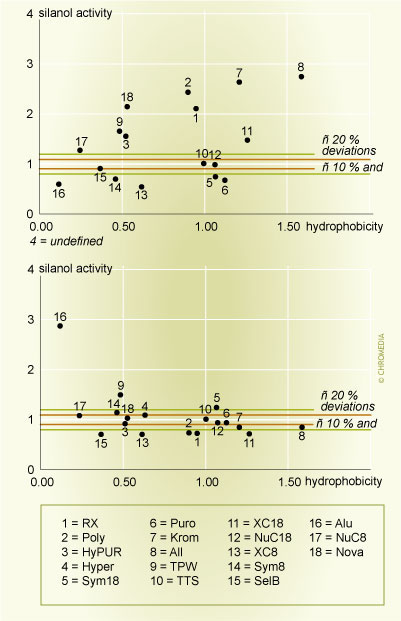 Normalized hydrophobicity vesus silanol activity plots for 18 different columns tested according to the non-buffered Engelhardt test ( upper ) and the pH 7 buffered modified Engelhardt test (lower) ; TTS reference column; straight line = normalized silanol activity line ; brown line = ± 10 % and green line = ± 20 % deviation line.
As can be expected, the column hydrophobicity (x-axis) is not changed by the addition of a buffer. Therefore, the separation of neutral analytes can usually be performed in unbuffered eluents. In contrast, it is obvious that the silanol activity (y-axis) of nearly all the columns changes substantially upon buffering the eluent at pH =7. Moreover, the column silanol activities become nearly equal (with the exception of column 16) upon eluent buffering. The silanol activities of several of the columns do not deviate from each other by more than 10 or 20% when buffered at pH=7.
To achieve constant stationary phase conditions and reproducible analysis of polar/ionic analytes, eluent buffering is mandatory. This can be illustrated by the separation below. It shows the separation of a test mixture containing neutral and basic analytes using a buffered (upper chromatogram) and an unbuffered mobile phase (lower chromatogram) is shown. Not surprisingly, the retention factors as well as the peak asymmetries of both the neutral compounds ethylbenzene (2) and penthylbenzene ( 5 ) are the same in both eluents. In other words for these neutral compounds the retention and peak asymmetry values remain unaffected irrespective from buffering of the eluent.In contrast to that the retention factors and peak asymmetry of both the ionic compounds nortriptyline (3) and amitriptyline (4) are strongly influenced upon buffering of the eluent. In the pH =7 buffered eluent, all four the analytes are well separated and the retention and selectivity prove to be very reproducible with RSD values between 0.07 and 0.33 %. In contrast, in the unbuffered eluent for the analytes amytriptyline and nortriptyline the retention, selectivity and peak asymmetry values may differ at each analysis and are not at all reproducible. Non-buffered and buffered eluents on a Bonus- RP column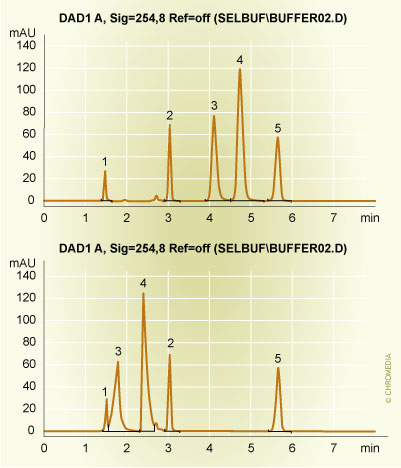 Comparison of non-buffered and buffered eluents on a Bonus- RP column.Conditions: eluents ; methanol -20mM phosphate buffer pH = 7.0 (upper) and methanol-water, 80 : 20 v/v (lower); Sample 1= uracil, 2= ethylbenzene, 3 = nortriptyline, 4= amitriptyline, 5= pentylbenzene.
RPLC phases are manufactured from various substrates which are modified using various synthesis steps, which has resulted in the commercial availability of several hundred different RPLC phases whose chromatographic properties vary with their different surface chemistries. This, together with the large number of possible eluent compositions, offers a nearly infinite number of conditions to solve separation problems. The variety can be overwhelming, however, when choosing a column for a specific analytical problem. In addition, no simple and uniform system to test and to rank RPLC columns according to their chromatographic properties, e.g. retention and selectivity, has been developed to date. Furthermore, other important column properties such as the chemical and thermal stability, reproducibility, and repeatability of RPLC phases are also determined to a great extent by their surface chemistries. Since these are important to the selection of a column, understanding the different surface chemistries is extremely important.