Abstract The great importance of the temperature in HPLC is demonstrated in a number of applications. This chapter offers an overview of applications of elevated temperature and temperature programmed liquid chromatography.
LevelBasic
Overview of applications of elevated temperature and temperature programmed liquid chromatography
The applications are arranged by field of interest:
- Fundamental
- Pharmaceutical
- Biochemical
- Environmental
- Chemical
- Food
- Polymers
Increasing efficiency and resolution by coupling columns at elevated temperature
A test mixture is used to demonstrate the effect of coupling columns on efficiency and resolution. (F. Lestremau, A. Cooper, R. Szucs, F. David, P. Sandra, J. Chromatogr. A 1109 (2006) 191-196)
Increasing efficiency/resolution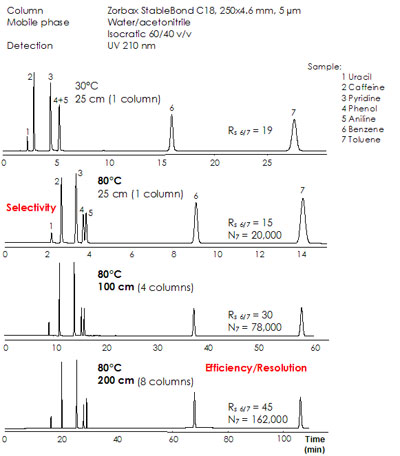
Green conditions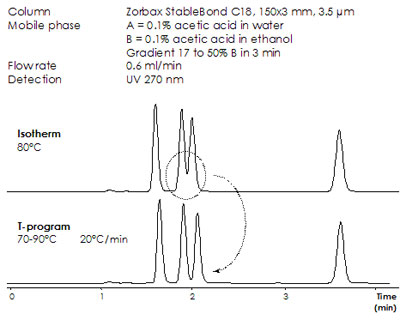
1. The method enables fast analysis of the various benzalkonium chloride homologues. Elevated temperature is combined with high flow rate. A volatile mobile phase is used enabling detection methods like mass spectrometry, corona aerosol discharge and evaporative light scattering.
Fast analysis of benzalkonium chloride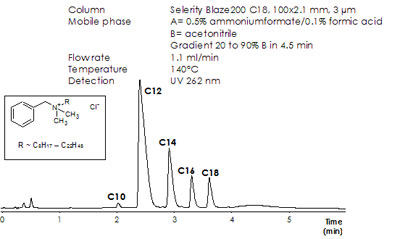
2. Temperature was used for the analysis of various benzalkonium chloride homologues in a pharmaceutical formulation. Selectivity is significantly affected by analysis temperature. Additionally, the use of high temperature speeds up the analysis.
Determination of benzalkonium chloride in pharmaceutical formulation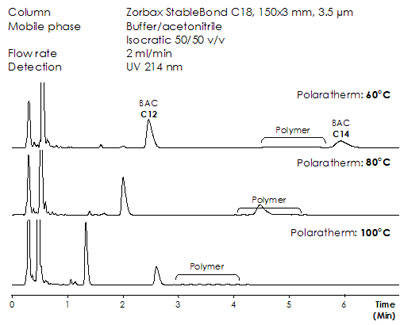
3. A mixture of a pharmaceutical compound and impurities is analyzed in a conventional and high resolution set-up. Significantly higher resolution is obtained with the same analysis time:
Analysis of pharmaceutical compounds – Increasing resolution I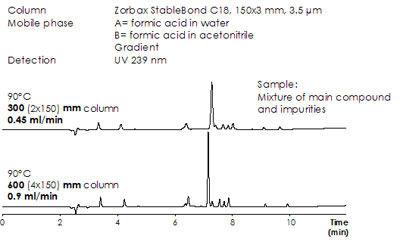
4 Analysis of pharmaceutical compounds – Increasing resolution:
Temperature and selectivity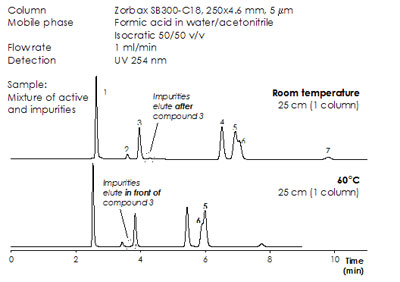
A complete separation of all compounds is obtained with the high resolution set-up (5 columns coupled in series).
Normal and high resolution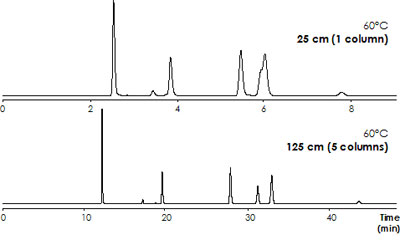
5. Influence of temperature on the analysis of sulfonamides
Selectivity and speed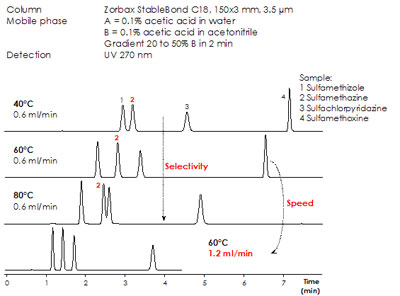
Temperature programming, green conditions: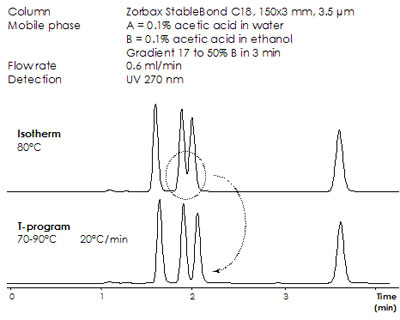
6. Comparison of solvent and temperature programming for the analysis of sulfonamides
A sulfonamide standard mixture is analyzed with LC-MS using a solvent gradient or a temperature gradient. A temperature gradient provides better peak shape and detectability. The ionization efficiency is not affected by changes in mobile phase composition when a temperature program is used instead of a solvent gradient.
Comparison of solvent and temperature programming 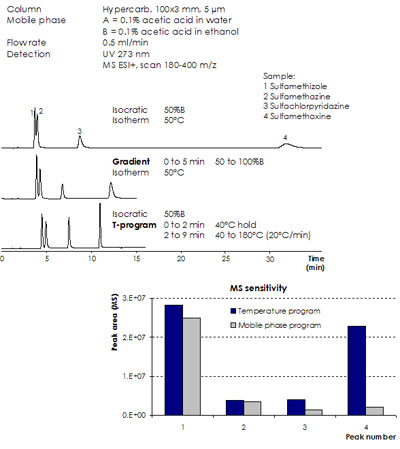 G. Vanhoenacker, P. Sandra, J. Sep. Sci. 29 (2006) 1822-1835
7 Analysis of sulfonamides on a temperature-responsive stationary phase
The surface properties and functions of a temperature-responsive stationary phase are controlled by temperature. Retention and selectivity can thus be altered by changing the analysis temperature.
Temperature-responsive stationary phase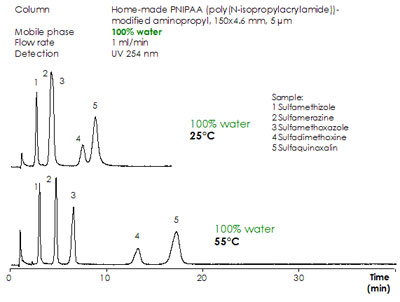 G. Vanhoenacker, P. Sandra, J. Sep. Sci. 29 (2006) 1822-1835
High efficiency separations of tryptic digest samples were obtained on conventional LC equipment by coupling eight 25 cm columns in series at 60°C. A peak capacity of ca. 900 was obtained using this set-up.
High efficiency separation of tryptic digest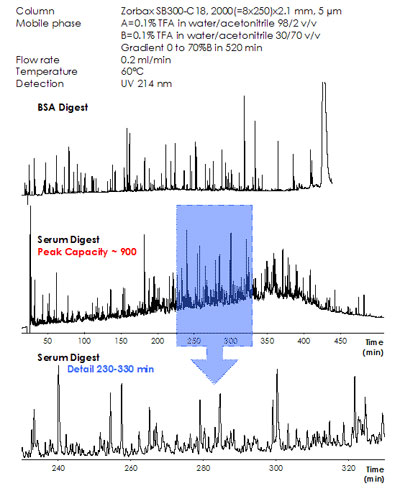 P. Sandra, G. Vanhoenacker, J. Sep. Sci. 30 (2007) 241-244
1. Significant temperature dependent selectivity changes can be observed for the mixture of a phenylurea pesticides. At elevated temperature, the flow rate can be increased to shorten the analysis time.
1. Fast analysis of phenylurea pesticides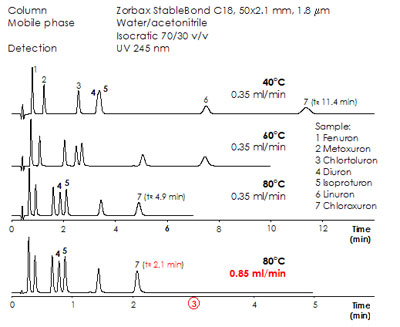
2. Influence of temperature on selectivity for the analysis of phenylurea and triazine pesticides:
Triazine pesticides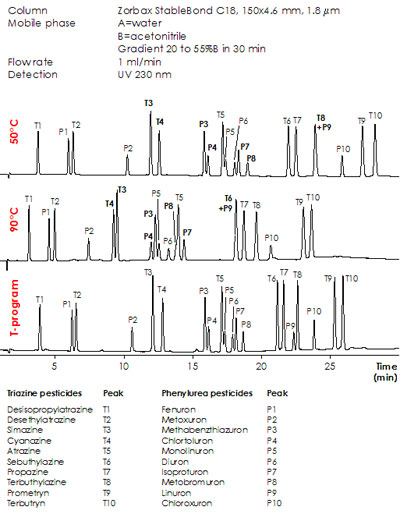 G. Vanhoenacker, P. Sandra, J. Sep. Sci. 29 (2006) 1822-1835
3. High efficiency separation of PCB mixture
A high efficiency separation of a polychlorinated biphenyl (PCB) mixture is obtained on conventional LC equipment by coupling eight 25 cm columns in series at 80°C. A peak capacity of over 300 was obtained using this set-up.
High efficiency separation of PCB mixture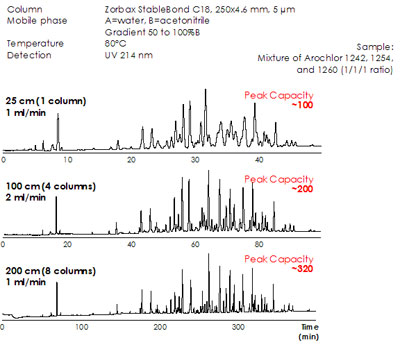 F. Lestremau, A. Cooper, R. Szucs, F. David, P. Sandra, J. Chromatogr. A 1109 (2006) 191-196
1. Analysis of naphthylamine isomers
Mobile phase selection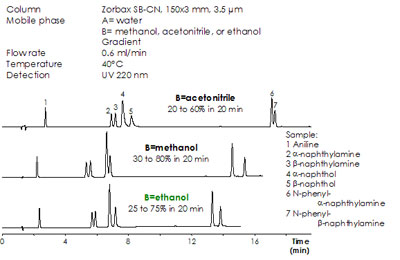
Green chromatography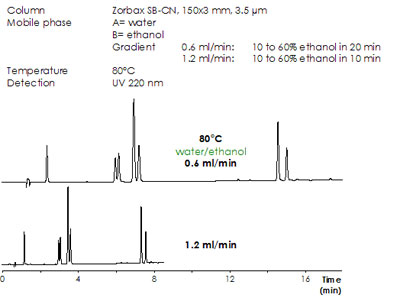
2. Polar compounds I
Resolution and speed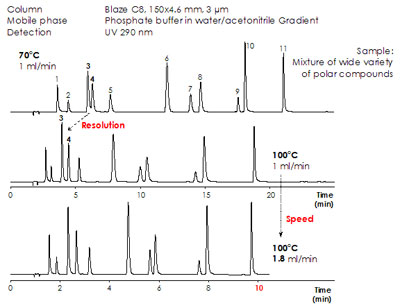
3. Polar compounds II
The use of a temperature program leads to a reduced analysis time and an improved signal-to-noise for the late eluting compounds.
Temperature programming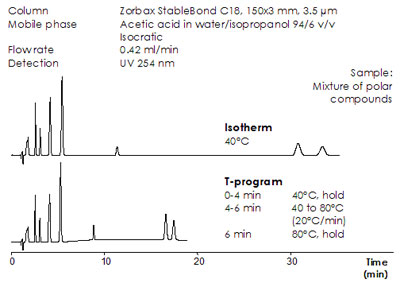
4. Polysulfides
An isothermic solvent gradient method for the analysis of a polysulfide sample is compared to an isocratic temperature-programmed method. Selectivity is significantly influenced by temperature and mobile phase composition (e.g. relative position in chromatogram of sulphur peak).
Polysulfides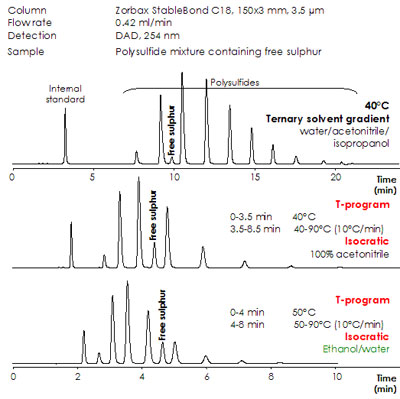
5. Increased resolution for the analysis of a complex reaction mixture
The resolution for a separation of various compounds in a complex reaction mixture is significantly improved by coupling columns in series.
Increased resolution for complex mixture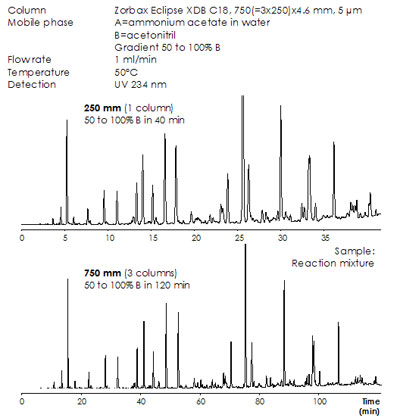
6. High efficiency analysis of phenones
The theoretical chromatographic efficiency(N) of an LC setup can be calculated as follows:
N = L/2dp (L=column length, dp = particle size)
Eight 25 cm long, 5 µm dp columns coupled in series should ideally yield ca. 200,000 plates.
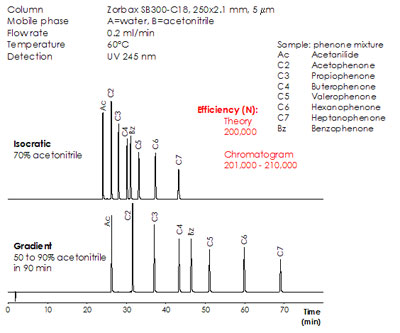
1. High resolution analysis of citrus extracts
Conventional columns were coupled in series to increase the efficiency and resolution for the analysis of a mixture of lemon and orange oil. The calculated peak capacity was approximately 260 for a 60 min gradient.
Citrus extracts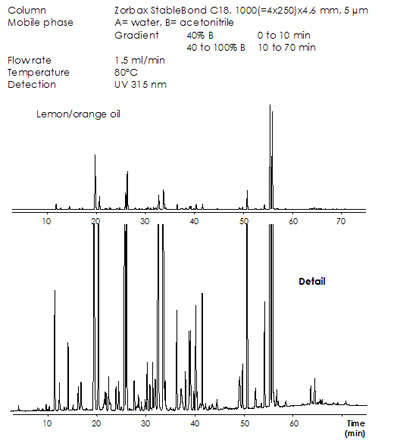 G. Vanhoenacker, P. Sandra, J. Sep. Sci. 29 (2006) 1822-1835
2. Sub-ambient temperature programming for the analysis of triglycerides
Sunflower oil is analyzed on a reversed-phase column under isocratic conditions using a sub-ambient temperature program to increase resolution.
Sunflower oil, sub-ambient temp programming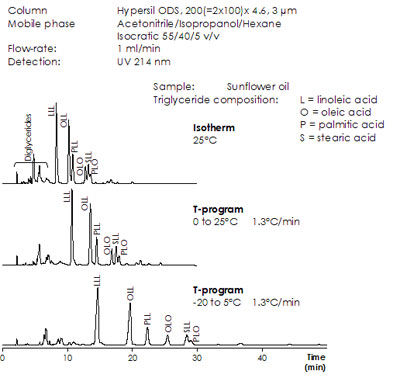
Influence of temperature on the analysis of octylphenol ethoxylates.
Selectivity for the analysis of octylphenol ethoxylates was significantly affected by temperature in reversed phase LC. The elution order of the oligomers was reversed comparing separations at ambient and elevated temperature.
Analysis of octylphenol ethoxylates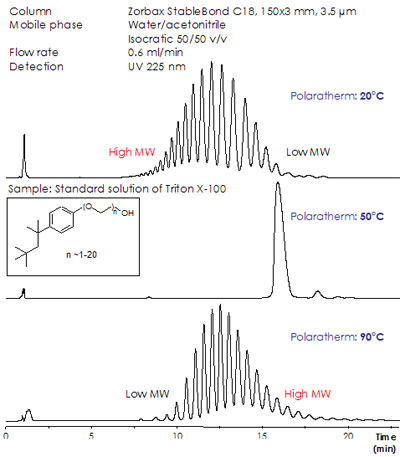 G. Vanhoenacker, P. Sandra, J. Chromatogr. A 1082 (2005) 193-202