Abstract Metabolism and degradation of organic compounds are two parameters that can have a major influence on the analytical procedure. In order to understand these parameters first of all a short introduction in the pharmacokinetic processes involved will be given.
LevelBasic
Pharmacokinetics involve the kinetics of drug absorption, distribution, metabolism and elimination (ADME):
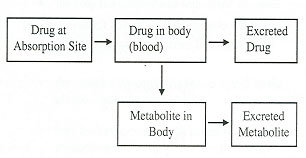
Summary of pharmacokinetic processes.
Absorption. Transport of the drug from the site of administration to the bloodstream;
Distribution. 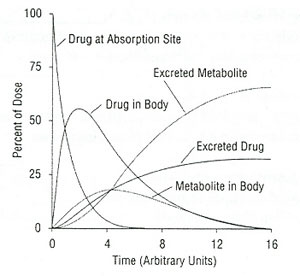 Movement of the drug from the bloodstream to extra vascular tissue (site of action);
Metabolism. Biochemical mediated alteration of the drug;
Elimination. Removal of the drug and/or metabolites from the body.
During bio-analysis, in addition to the parent compounds, also metabolites and/or degradation products can provide valuable information on the sample. This means that in many cases, the parent compound should be determined simultaneously with its metabolic and or degradation products. In general it can be stated that degradation products and, to lesser extent, metabolites are interfering compounds and should be removed during the sampling and SP procedure. For an accurate interpretation of the data, and analytical chemist always should be aware of potential metabolites or degradation products.
Biotransformation reactions. 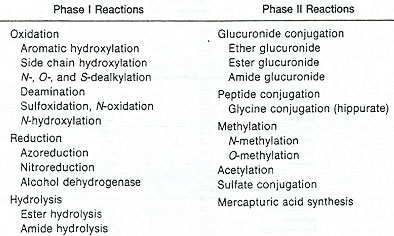
A definition of metabolism can be the combination of all chemical reactions occurring in living cells. These reactions are allowing cells to grow, reproduce and interact with the environment. Metabolism can be divided in catabolic and anabolic reactions.
The catabolic reactions provide the necessary energy (e.g. breakdown of food) for the organism, while the anabolic reactions are using this energy (e.g. synthesis of proteins).
Macromolecules (e.g., polysaccharides, proteins) cannot be rapidly taken up by cells are degraded into smaller parts before they are used in the cell metabolism. 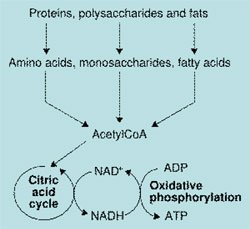
For these catabolism reactions several types of enzymes can be used. For example, proteases digest proteins into amino acids and glycoside hydrolases digest polysaccharides into monosaccharides. Catabolism of proteins (www.bact.wisc.edu).
Carbon fixation is an example of an anabolic reaction. Photosynthesis is the synthesis of glucose from sunlight, carbon dioxide and water (oxygen is produced as waste product). ATP and NADPH (co-enzymes) convert carbon dioxide in glycerate-3-phosphate, which is then converted into glucose. Both ATP and NADPH are produced by photosynthetic reactions.
Another process is the detoxification of xenobiotics, including drug molecules. Xenobiotics are detoxified by special enzymes including cytochrome P450 oxidases and glutathione-S-transferases. 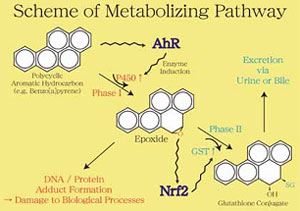 The metabolizing pathway of polycyclic aromatic hydrocarbons is given here:
Metabolism of benzo(a)pyrene (http://mol-devserver. tara. tsukuba.ac.jp).
Although metabolism and degradation are related there is a distinct difference between these two processes. For example bupropion:
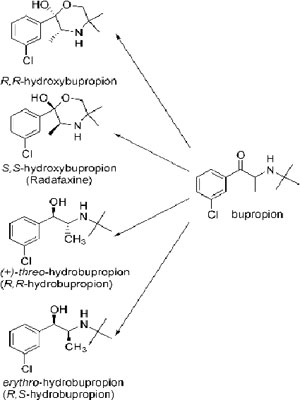 1. Bupropion is metabolized in the liver to R,R-hydroxybupropion, S,S- hydroxybupropion, threo-hydrobupropion and erythro-hydrobupropion and further metabolized to inactive metabolites and eliminated via the urine.
2. Bupropion was developed to decrease side effects associated with pH induced degradation products. For bupropion a pH dependent degradation pathway is described. The observed degradation products at pH 7 are shown 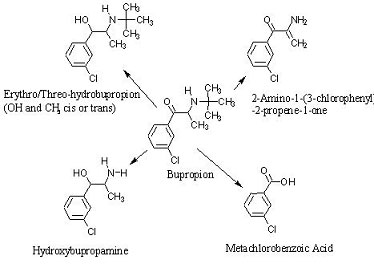
To make the distinction between degradation and metabolism clear, degradation can be defined as the chemical breakdown of compounds by physico-chemical effects. However, in some cases the terms metabolism, metabolic degradation and degradation are mixed.
Amino acid degradation 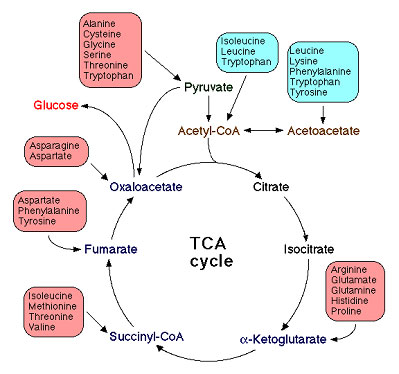 http://138.192.68.68/bio/Courses/biochem2
The result of metabolism and degradation is that early metabolite testing using, for example, LC-MS/MS approaches is a must in bio-analytical chemistry: 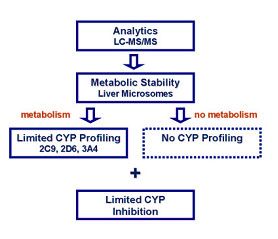 Early metabolite testing (www.genpharmtox.com).
Since every exogenous compound entering the body should be eliminated, drug metabolism is an important feature. Therefore, drug metabolism is focused on the conversion of body-foreign solutes into highly water-soluble compounds that can be excreted easily via the urine. Any ’first pass’ effect will influence the ratio of the analyte and its metabolites and so their concentration in the various biological fluids. An example is the fast hydrolysis of esters to free carboxylic acids, which will rapidly conjugate and excreted via the urine.
Metabolism is an integral part of drug administration and it may affect the pharmacological effect of a drug. The metabolites formed can be pharmacologically active or inactive. Active metabolites may have different modes of action and different potencies and the formation of active metabolites changes the profile of drug action.
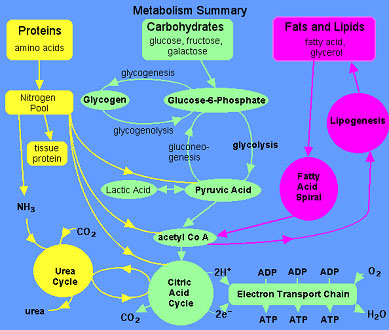
Drug metabolism can be divided into two different types of reactions:
- Phase I mechanisms involve oxidation, reduction and hydrolysis reactions.
Phase I reactions include oxidation, hydroxylation, N- and O-dealkylation and sulfoxide formation as well as reduction and hydrolysis reactions. Many drugs undergo a combination of phase I and phase II reactions. - Phase II reactions involve conjugation of these metabolites with polar endogenous solutes (e.g., glucuronic acid, hippuric acid, sulphate).
Phase II reactions include conjugation reactions, such as with glucuronic acid, as well as acetylation, methylation and conjugation with amino acids and sulfate. Phase II reaction remove or mask functional groups (e.g. amino, carboxyl, hydroxyl, sulfhydryl) on the drug or a Phase I metabolite by the addition of an endogenous substrate:
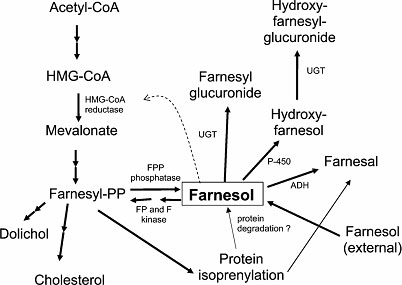 Metabolism of farnesol (www.biochemj.org).
An additional problem in developing a bio-analytical procedure is that plasma levels in some patients are relatively low. One of the reasons is that one group of patients can be considered as fast metabolizers, while another group are slow metabolizers which results in increased plasma levels. However, high or low plasma levels are not always due to a slow or fast metabolism.
Drug response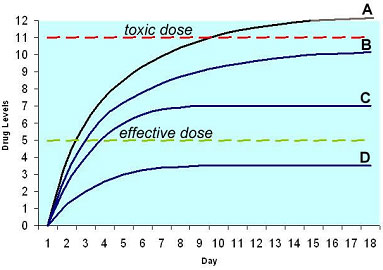 www.healthhanddna.comA. PM poor metabolizer, absent or greatly reduced ability to clear or activate drugs; B. IM intermediate metabolizer. Heterozygotes for normal and reduced activity genes; C. EM extensive metabolizer. The norm; D. UM Ultra Metabolizer. Greatly increased activity accelerating clearance or activation.
A number of features, in addition to the physico-chemical properties of the analyte, such as administration route, concomitant administration, degree of drug-protein binding, dose, formulation, partition volume, solubility, speed and degree of absorption and elimination, time of administration – before, during or after meal – and gastrointestinal disturbance will influence the plasma levels. This means again that selectivity and sensitivity are among the key parameters in bio-analytical procedures. The required selectivity of the bio-analytical method depends on the formed metabolites, the degradation processes, and the presence of interfering compounds in the biological matrix. In urine, normally, significantly more interferences are observed compared with plasma, while saliva is a relatively clean matrix.
Depending on the functional groups present – i.e., amine, carboxyl, ether (nitrogen or oxygen), ester, phenol, and hydroxyl – the parent compounds can be oxygen or nitrogen dealkylated, followed by conjugation of the oxygen/nitrogen atom forming water soluble solutes that can be excreted via the urine As a result the concentration of the parent analyte(s) in plasma or serum can be relatively low, while the concentration of the corresponding metabolites is relatively high in urine. This is the case for analytes which are extensively metabolized. It will be clear that urinary excretion is the most important elimination pathway for exogenous compounds. But in case the renal function is disturbed, plasma concentrations can be increased.
Analyte stability is of utmost importance. This means that during all steps of the analytical procedure the stability of the analyte(s) should be checked. In other words the sample studied must be representative of the object under investigation. This means that biological, chemical and physical processes that may influence the composition of the sample are collection should be carefully checked. The biological processes involved are biodegradation and enzymatic reactions, the chemical processes can be hydrolysis, oxidation, precipitation and photo instability, while the physical processes that can cause problems are, for example, adsorption, diffusion and volatilization.
Since samples are normally not stored under exactly the same conditions as the original source it is not possible to guarantee the integrity of a sample for indefinite time. Therefore, samples must be preserved during the time the analytical cycle is completed. This can be done by performing tests how long a sample can be stored without degradation occurring. Analyte stability in solution and analyte stability in the matrix are discussed separately.
Normally standard solutions of analyte(s) are made. This means that it should be known during which period and under which conditions these solutions can be stored. In case this type of information is not available, the solutions should be prepared freshly until sufficient data are available, this to avoid the use of standards with an unknown or not precisely known concentration which can result in errors in the quantitation of unknown samples.
In addition to the stability of standard solutions, also the stability during all steps of the SP/ST should be monitored. For example:
- An effective way of deproteination of plasma samples is by using perchloric acid or trichloroacetic acid. A number of compounds – in particular esters – however, are not stable at pH values of 2 and lower. This means that this approach cannot be used in combination with this type of compounds.
- A number of pesticides are hydrolyzing relatively fast in aqueous solutions (Figure 2.63) or are photochemically not stable. This means that in case these compounds must be determined in surface water, also the hydrolysis products should be determined in order to avoid an underestimation of the concentration of the parent compound.
In addition to the stability of the analyte in solution also its stability in the matrix is important. In this respect three parameters are of importance that are worth testing:
1. What is the time period that a sample can be stored at room temperature or deep frozen before it is degraded in such a way that it is not acceptable anymore?
These data are important to determine how much time there can be between the collection of the sample (sampling) and the moment the sample is frozen, the time period that samples can be stored and time samples can be stored in an autosampler.
In order to study the stability at room temperature, an experiment can be performed during 24 h using a spiked sample of which an aliquot is analyzed (in triplicate) every hour or every two hours. In the case of homogenous liquid samples (e.g., body fluids, water samples), 24 hours normally is sufficient. Dealing with solid or semi-solid samples (e.g., faces, sediment) the stability should normally be studied during a longer period. An exception is urine; this because the ‘composition’ of this fluid is depending on many parameters the stability frequently is studied for a period of 24–48 h. When the sample seems not to be stable, it should be studied what should be done to avoid degradation. This means that either anti-oxidants, enzyme inhibitors, preservatives or algae inhibitors can be added.
After freezing of the sample the stability should be studied continuously during the whole time period of storage. In this case samples spiked with the analyte(s), at two different concentration levels, are divided in several aliquots. These aliquots are measured, in duplicate or triplicate, at indicated time points to find out the degree of degradation during such conditions. The time period of such a stabilization study depends on the requirements with respect to the stability, although it is advised to determine always the maximum time the sample can be stored.
In this case the results indicate that the sample is not completely stable, additional experiments must be performed to indicate the maximum time of storage.
The most usual storage temperature for many samples is -200C. Blood plasma normally is in the solid state at this temperature. However, just around the macromolecules (e.g. glycoproteins) that are present the water molecules still have sufficient potential energy to be ‘mobile’ and to take part in a degradation reaction. Urine and other samples with a high ionic strength (e.g. waste water) even can contain micro-drops of water at -250C. In principle, every laboratory should have the facilities to store samples at -400C and -800C, to avoid the degradations problems sometimes occurring at -200c. A solution of avoid this type of problems is to freeze-dry the samples before they are frozen.
2. What is the effect several freezing – thawing cycles of the sample?
This effect can be studied by spiking the matrix (sample) with known concentrations of the analyte(s) and test aliquots of this solution with several free-thaw cycles. This approach normally provides sufficient information on the possibilities of thawing and freezing the same sample more than once. However, this only is the case when all degradation products and metabolites are known. Unknown compounds can degrade into several parts during this type of procedures.
3. What is the stability of sample extracts?
With a last series of experiments the stability of the extracts, obtained after SP/ST, should be determined. This type of information will provide information on how many samples can be processed simultaneously, what the maximum time can be between the SP/ST and the actual analyses.