Abstract In general, nominally identical RPLC columns from different manufacturers are not interchangeable without adjustments to the analysis and revalidation. This article describes the major parameters.
LevelAdvanced
Especially in routine analyses chromatographers want to be able to replace a given RPLC column with the same type and brand of column without interrupting or adjusting the analysis procedures. This becomes absolutely essential when an analysis is performed with validated protocols or for interlaboratory studies. In general, nominally identical RPLC columns from different manufacturers are not interchangeable without adjustments to the analysis and revalidation.
Unfortunately, even when using columns of a single manufacturer and brand, analysts are often confronted with problems arising from the  batch to batch (ir)reproducibility of their columns. These problems tend to be more likely and serious for more polar or more ionic analytes. Market demand has fuelled substantial scientific and technical effort among manufacturers, resulting in the manufacture of much more reproducible RPLC phases in the last decade. In general, modern RPLC phases and columns show batch to batch reproducibilities that meet the requirements of many analysis protocols, at least for neutral and not-too-polar analytes.
- Column to column reproducibility: Provides information on the distribution of chromatographic properties, e.g. retention factors and efficiencies, among columns produced either within a single batch or in different production batches.
- Batch to batch reproducibility: Reflects the distribution in the chromatographic properties between different production batches.
- Short term repeatability: Provides information on the repeatability of a number of consecutive chromatographic measurements on one column under invariant conditions during a short period of time, i.e. hours or days.
- Long term repeatability: Provides information on the repeatability of consecutive chromatographic measurements on one column under exactly the same conditions over longer periods of time, i.e. weeks or months.
Since the interactions between analytes, eluents and columns can be very complex, the measured RSD’s may differ among different analytes. In other words, these results will depend substantially on the test mixtures viz. neutral, acidic or basic compounds used to quantitate repeatability or reproducibility. As an example the column to column and batch to batch reproducibilities, as well as the short and long term repeatability of the Symmetry C-18 RPLC phase are illustrated in the figures below.
Repeatability and reproducibility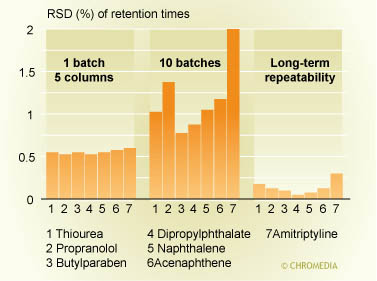
Repeatability and reproducibility (2)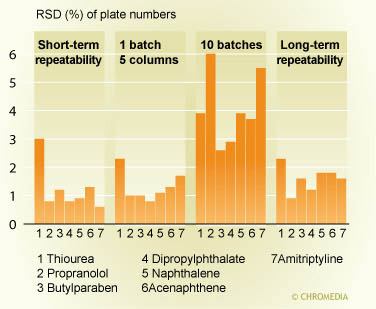 The retention times and plate number repeatabilities of a Symmetry C-18 column ( Waters, Milford, MA USA ) were measured with methanol/aqueous buffer, 65: 35 v/v at pH = 7.0 with monobasic/dibasic potassium phosphate; temperature = 25° C; UV detection at 254 nm
The figure indicates that the column reproducibility from one batch and the long term column repeatability of retention times are approximately 0.6 and 0.2 %, respectively. Columns produced from 10 different batches show reproducibilities that average 1.0 %. That is, with the exception of both of the basic test components propranolol and amitryptaline, which show significantly higher RSD’s. In terms of plate numbers, the short and long term repeatabilities and column reproducibility within a batch average between 0.8 and 1.8% RSD for all of the analytes but thiourea. The plate number variation between batches is between 2.0 and 3.9% RSD, with the exception of both basic test components, propanolol and amitryptaline, which showed much higher RSD’s.
Current state of the art manufacturing processes generally result in column to column reproducibility in the tenth of percent range and batch to batch reproducibility on the order of 2 to 3 %. These values assume measurement with a number of different test mixtures and are generally even better for neutral compounds. Generally, analytical laboratories’ demands with respect to reproducibility, repeatability, and the long term availability of RPLC phases and columns have been  met, with the exception of basic analytes. However, manufacturers are constantly improving RPLC phase and column manufacturing techniques, and new generations of columns meeting the ever stricter demands of the market can be expected.