Abstract A large variety of RPLC phases presently available offers selectivity, high efficiency, reproducibility and satisfactory chemical and thermal stability. In many cases these RPLC phases now meet the most demanding requirements of analytical laboratories. This chapter describes a number of aspects in the structure and preparation of the stationary RPLC phases.
LevelAdvanced
Silica is still the substrate of choice for the manufacture of the majority of RPLC stationary phases. Generally, the preparation process consists of a number of well defined steps:
- Pretreatment
- Chemical modification. The chemical modification step is performed by refluxing the silica substrate in an inert solvent together with reactive organosilane reagents and a catalyst or scavenger. During this step a portion of the hydroxylated silanols is modified by the organosilanes. Depending on the intended reaction results, viz. monfunctional versus controlled polymeric bondings, these modification steps are carried out under various strictly controlled, often completely water-free conditions.
- Washing. After the surface modification reactions, the phase is washed thoroughly.
Over the years a number of different approaches have been developed for an efficient and reproducible modification of silica and other substrates in order to create useful RPLC phases. Common modification approaches in the manufacture of RPLC phases are:
- Hybrid organic-inorganic, bidentate, horizontal polymerization syntheses,
- The use of many different halo-and alkoxysilanes.
Halo-and alkoxysilanes are probably the most common routes for the chemical modification of silicas. These reagents are available as  mono, di or trifunctional reactive organic reagents, resulting in different covalent bondings of functional ligands (R) to the silica surface.
This formula gives a general scheme for the reactions between silanols and halo-or alkoxysilanes:
Si-OH + X-Si (Y)2-R -> Si-O-Si (Y)2-R + HX
X = halogen or an alkoxy group Y = halogen, alkyl, or alkoxy group
The illustrations below show the reaction products using mono, di-and trifunctional halogensilane reagents for the synthesis of silica based RPLC phases.
Silica surface modification (1) with mono, di, and trifunctional chlorosilanes under dry conditions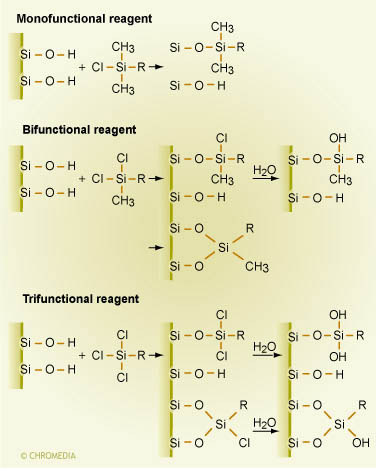
Silica surface modification (2) with di and trichlorosilanes under wet conditions, resulting in polymerisation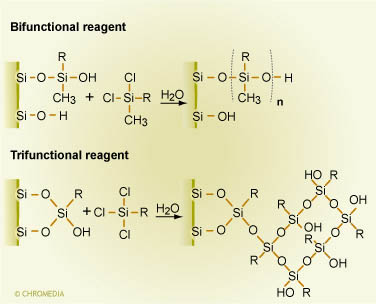
These different reagents result in the formation of different mono- and polymerically modified silica-based RPLC phases.
Obviously, the ligands can be attached to a silica substrate by a variety of different bondings in modified RPLC phases. The type of bonding substantially influences the chromatographic, chemical and thermal stability of these phases.  In phases where di-and trifunctional reagents are used, the ligands are bonded to the substrate as an interconnected network.
As a consequence, these di- and trifunctional phases  usually show separation properties that are distinct from their monomeric counterparts.
At present the vast majority of available RP stationary phases is monomeric.
Apart from the modification using silanisation reagents, other synthetic 'routes' are used for the manufacture of RPLC phases. In the illustration below, some examples of conventional and more advanced types of RPLC phases are presented:
Types of phases with different stabilities.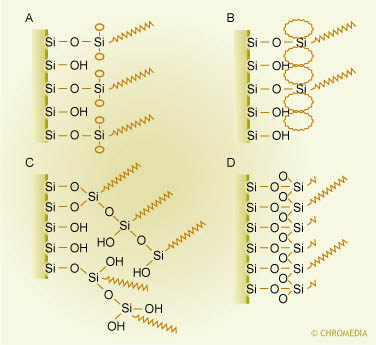 Examples of conventional and advanced RPLC phases; A = monofunctional C-18 phase with dimethyl sidegroups; B = monofunctional C-18 phase containing bulky side groups; C = vertically polymerized C-18 modified silica; D = horizontally polymerized C-18 modified silica
The illustration shows the commercially available and commonly used silica-based RPLC phases of different functionalities, along with typical designations.
Examples of commonly used bonded phases.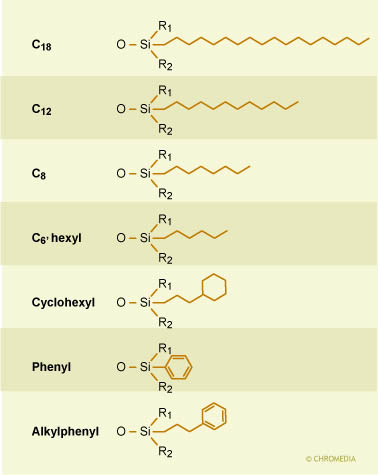
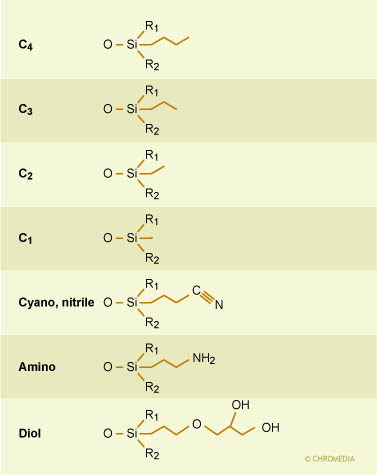
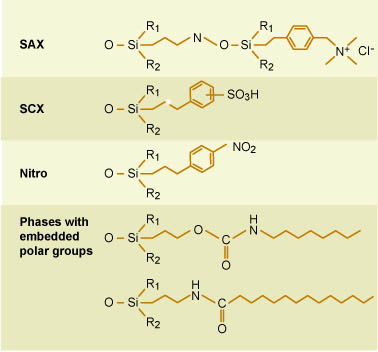
Due to steric hindrance during the surface modification step, less than 50 % of the originally available silanols can be modified by the organic-functional ligands. Therefore, in an attempt to further reduce the activity of the residual silanols, manufacturers often employ a second “endcapping” synthesis step after the initial chemical modification.
The illustration below presents an example of an endcapped C-8 RPLC phase.
During the first synthesis, this silica is treated with a monofunctional octylmonochlorodimethylsilane reagent. In the subsequent endcapping step, the synthesis product is reacted with a monochlorotrimethylsilane reagent to help eliminate residual silanols. The trimethylsilane groups attached in the second synthesis step can be seen clearly in the illustration (Si-O number 5 and the bottom Si-O were 'endcapped'.):
Silica based C-8 modified stationary phase with trimethylsilane endcapping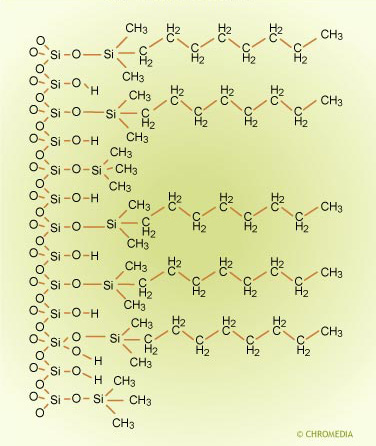
Apart from the reduction of the residual silanol activity, endcapping also increases the hydrophobicity of RPLC phases. Because of the limited chemical stability of some of these di- and trimethylchlorosilanes endcappings under aggressive eluent conditions, more sophisticated endcapping reagents are also applied in some cases.
The surface coverage equals the number of moles of ligand divided by the surface area of the parent silica, and is expressed as (µmol ligand) / (m² of substrate material).
High and low coverage bonded rplc phases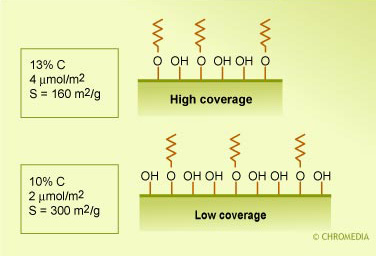
For monomeric bondings a typical surface coverage might be 4 µmol/m2. The surface coverage indicates the density of ligand chains on the surface:
- A highly loaded phase, with perhaps 4 µmol/g, possesses many chains per unit area and is fairly nonpolar as a consequence of the relatively few free silanol groups left on the surface.
- In contrast, at low surface coverages of e.g. 1. 6 µmol/g, the number of ligand chains per unit area is small and the effect of the free silanols will be more apparent.
The following table presents the example of two monomeric stationary phases, both with specific areas of 162 m2/gr and nearly identical surface coverage, but with different ligands.
| Stationary phase | %C | Coverage | Specific surface (m2/g) |
| Mono C8 | 6. 8 | 3. 9 | 162 |
| Mono C18 | 12. 4 | 3. 8 | 162 |
The conformation of the ligands at the stationary phase surface depends:
- On the ligand itself
- On the nature and the amount of organic modifier in the mobile phase.
This is demonstrated schematically in the left picture, which shows the behaviour expected with a 95 volume % water (or aqueous buffer) mobile phase and alkyl chains: an unstable, matted alkyl chain configuration at the RPLC stationary phase surface. Under these conditions the alkyl chains are not properly solvated by the nearly aqueous eluent. In other words the stationary phase is poorly wetted by the eluent.
Poorly wetted (left) and a completely wetted (right) rplc phase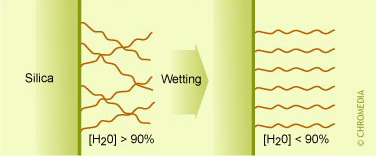
As a consequence, the ligands form an entangled network in order to minimize contact with the highly aqueous mobile phase. This is especially likely to occur in C-18 phases since the carbon-carbon bonds in these ligands are flexible, allowing such conformation changes.
Stagnant mobile phase inside the pores can also create this effect if the water content of the eluent is adequate. Such highly aqueous mobile phases may cause irreproducible chromatographic results since:
- These conformation changes may result in reduced contact between the stationary phase and the analyte molecules.
- The mobile phase is slowly excluded from the stationary phase pores resulting in long equilibration times between the eluent and the stagnant mobile phase in the pores.
These unwanted effects can result in irreproducible retention factors and low column efficiencies.
Thus, to maintain chromatographic quality, a minimum quantity of modifier must be added to the mobile phase to effect ligand salvation, as shown in the right part of the illustration.
Limited chemical stability, especially at higher eluent pH values, is the principal drawback of silica substrates. To overcome this serious limitation, alternative substrates and phases and new silica stability-enhancing modification techniques have been developed.
The goal in the developing such phases is threefold:
- To improve the chemical and thermal stability of stationary phases.
- To increase the shielding of unwanted residual reactive groups.
- To circumvent the incompatibility of the complex surface chemistry of specific substrates with commonly applied modification reactions.
Polymer coated, polymeric and graphitized carbon packings have all been developed to address these needs in RPLC:
In polymer coating or polymer encapsulation techniques, a thin polymer film (e.g. C-18 modified polybutadiene or polyacrylamide) is extended across the surface of a substrate. Zirconia and alumina are frequently used to produce polymer-coated RPLC phases and are notable for their higher chemical and thermal stability relative to silica. Usually, these polymerisation processes are performed under free radical cross linking and/or heating conditions. As a result, the polymer film is physically adsorbed to the substrate surface, in contrast the chemically-bonded surface modification produced with organosilane treatment. Given their properties, polymer encapsulated phases are employed in situations requiring high pH and thermal stability. In spite of their favourable properties, these phases have found only limited use in laboratory practice for a number of reasons.
The polymeric and graphitized phases are commonly used:
The present generations of polymeric phases meet the demands placed on high quality HPLC stationary phases. These phases usually consist of highly cross linked copolymers and are manufactured by a (co-) polymerisation of monomers. Like silica, polymer phases can be manufactured in a large number of different morphologies and particle sizes. The particles consist of a network of much smaller microspheres, providing a polymer phase that is actually a continuous pore network.
RPLC stationary phases based on styrenedivinylbenzene, methacrylates and polyvinylalcohols are well known examples of such macroporous RPLC phases. These stationary phases can be used as-is, or may be subjected to a subsequent surface modification step. In the figure below, the chemical surface structures of both the basic styrenedivinylbenzene and the C-18 grafted polymer are presented.
Styrenedivinylbenzene without (A) and with C18 (B)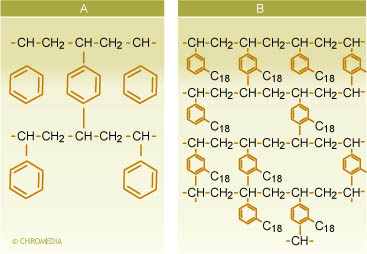 RPLC phases based on styrenedivinylbenzene (A) and styrenedivinylbenzene modified with C-18 ligands (B).
Present generations of polymeric RPLC phases have a high hydrolytic stability and are compatible with most of the organic solvents commonly used in RPLC. Furthermore, these polymeric phases have sufficient mechanical strength to allow their use under elevated pressure conditions. This, the facility with which they are modified (particularly into ion exchangers), and their applicability to the separation of biopolymers explain the popularity of polymeric phases in HPLC.
Graphitized carbon RPLC phases are manufactured by:
- Depositing organic monomers in the pores of a silica substrate, which serves as a template.
- Next, this silica is subjected to polymerization, carbonization, graphitization and dissolution steps.
- In the dissolution step, the silica template dissolves away, leaving its graphitized carbon replica.
The selection of the silica template determines the morphology of the resulting graphitized phase, including particle size, porosity and surface area.
Graphitized carbon RPLC phases consist of a network of intertwining graphite ribbons. The chemical and mechanical stability of these phases is high. However, the chromatographic properties of graphitized carbon phases are generally different from their silica based counterparts, especially for polar analytes. Carbon phases are mostly applied in special separation areas such as the separation of structural isomers and carbohydrate samples.
- Nature, purity, and pretreatment of the substrate.
- Modification reagents and reaction conditions.
- Nature, side groups and density of attached ligands.
- Nature and concentration of residual silanol or other active groups.
- Endcapping reagents and reaction conditions.
- Residual metals contamination.
In spite of the complexity of the process, manufacturers have successfully developed and are producing a large arsenal of high quality RPLC phases. In addition, ongoing market demand stimulates further improvement of RPLC phases, with manufacturers regularly introducing new RPLC phases. ' Batch-to-batch’ reproducibility is an extremely important requirement in the preparation of a stationary phase. Thus, stringent specifications must be used in synthesis, bare silica manufacture, and column production:
- The quality of each reagent involved in the synthesis should be specified and each step must be described in great detail.
- Every subsequent step in the production, including the column packing procedure, should be specified as well.
- Together, these instructions and specifications determine the final column-to-column reproducibility.