Abstract The mobile phase together with an RPLC phase forms a separation system. Column type, nature and composition of the mobile phase are decisive factors and key to success or failure of a given separation. Therefore, knowledge of the physico-chemical properties of solvents and mobile phases and the interaction with stationary phases and sample components is indispensable to optimize the mobile phase composition. Also this knowledge is important to understand and predict retention and selectivity processes. This chapters supplies this essential know how.
LevelAdvanced
In selecting the optimal composition of a mobile phase the chromatographer is led by:
- The desired thermodynamic and kinetic properties of a separation system:
- The polarity of a mobile phase determines to a large extent retention and selectivity of a given stationary phase / mobile phase combination.
- The viscosity of the mobile phase determines the kinetic properties a separation system, such as pressure drop across the column.
- The compatibility of a mobile phase with the detection system.
- Toxicity, costs, mixibility and flammability are decisive factors in the choice of solvents.
In practice the composition of a mobile phase in most cases will have to be a compromise.
Thermodynamic and kinetic properties of solvents and mobile phases are decisive in the choice of the mobile phase composition. Key factors are viscosity and to a lesser extent surface tension.  Remember that the viscosity of a mobile phase also determines the pressure drop across the column
The table summarizes a number of important properties of some frequently used solvents in normal and reversed - phase chromatography. These properties vary, in general, not proportional to the composition of a mobile phase.
| BP | Visc cP | Refr. index | UV-cutoff | Dielectr | Dipole mom D | Surface tension | |
| Hexane | 69 | 0,3 | 1,375 | 195 | 1,89 | 0,08 | 18,4 |
| CCL4 | 77 | 0,97 | 1,46 | 263 | 2,24 | 0 | 26,8 |
| Benzene | 80 | 0,65 | 1,501 | 278 | 2,28 | 0 | 28,9 |
| Diethylether | 35 | 0,24 | 1,352 | 218 | 4,3 | 1,15 | 17,1 |
| Methyl tert.-butylether | 55 | 0,27 | 1,369 | 210 | --- | 1,32(a) | 19,4(a) |
| Dioxane | 101 | 1,37 | 1,422 | 215 | 2,25 | 0,45 | 34,5(a) |
| Tetrahydrofurane | 66 | 0,55 | 1,407 | 212 | 7,58(a) | 1,75(a) | 26,4(a) |
| Ethylacetate | 77 | 0,45 | 1,372 | 256 | 6,02(a) | 1,88(a) | 23,8 |
| Chloroform | 61 | 0,57 | 1,446 | 245 | 4,81 | 1,15(a) | 27,2 |
| Dichloromethane | 40 | 0,44 | 1,424 | 233 | 9,08 | 1,14(a) | 28,1 |
| Acetone | 56 | 0,36 | 1,359 | 330 | 20,70(a) | 2,69 | 23,3 |
| Acetonitril | 82 | 0,36 | 1,344 | 190 | 37,5 | 3,44 | 19,1 |
| 2-propanol | 82 | 2,4 | 1,377 | 205 | 18,30(a) | 1,66(b) | 21,8(c) |
| Methanol | 65 | 0,55 | 1,328 | 205 | 33,6 | 2,87 | 22,6 |
| Acetic acid | 118 | 1,3 | 1,372 | --- | 6,15 | 5,15 | 27,8 |
| Water | 100 | 1 | 1,333 | <190 | 80,37 | 3,11 | 73 |
This figure (A, B and C) shows the large differences in viscosity curves for the in RPLC frequently applied solvents water, methanol, acetonitrile and tetrahydrofuran for the viscosity, surface tension and dielectric constant. Note the  large differences in the viscosity curves (η) for water / methanol versus water / acetonitrile.
Surface tension, dielectric constant and viscosity as function of percentage of modifier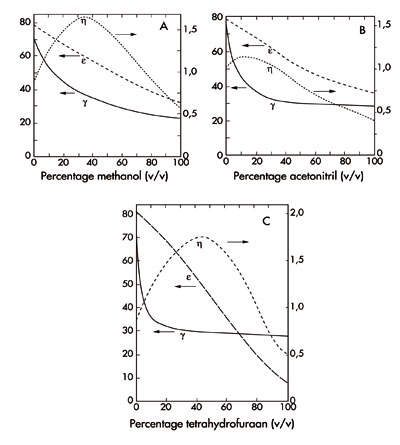
In general, in HPLC and RPLC the thermodynamic properties of solvents and mobile phases can be divided into two groups, namely according to their influence on:
- Elution strenght. The elution strengh, and therefore the overall retention and analysis time of a given separation is determined mainly by the polarity of the mobile phase.
- Selectivity. The selectivity of the mobile phase depends on the extent to which a mobile phase can have specific molecular interactions with column and components. Mobile phases thus can have identical elution strength, but their selectivity may be not the same.
Currently three methods are used to describe the influence of polarity on the mobile phase:
A. The solubility parameter concept
This concept is based on the thermodynamics of regular and athermic solutions. It can be used to describe and to predict retention and selectivity qualitatively.
B. The "Quantitative Structure Retention Relationship" (QSRR) model
The (QSRR) model considers the following properties of mobile phases as the main factors for retention and selectivity:
- dipole moment/polarisability (π*)
- protondonor (α)
- acceptor (ß)
The quantities π*, α and ß are in principle determined experimentally from the spectral shifts of specific test compounds in solvents. For example, the total polarity of solvents and mobile phases can be calculated on the basis of spectral shift of the test compound 2,6-diphenyl-4 - (2,4,6-trifenyl-N-pyridinio) fenolaat (ET-30) herein.
C. The solvent selectivity triangle (SST) model by Snyder
This model is used very often for the classification of solvents. In the SST model, the relative contributions of the three variables π*, α and ß are measured relative to ethanol, dioxan and nitromethane.
As with the QSRR model, also in the SST model dipole interactions and proton donor / acceptor properties are considered to be the most important parameters.
- Ethanol is considered primarily as a proton-donor (α ),
- while dioxan represents proton acceptor (ß) properties.
- With the help of nitromethane mainly the relative contributions of dipole - dipole interactions (π*) can be calculated.
- Also from these data the total polarity P of mobile phases can be derived.
The SST model has led to a qualitative classification of solvents on the basis of π*, α and ß *- values resulting in the well known Snyder triangle of solvents. By mixing solvents a very large number of different mobile phase compositions with varying elution strenght and selectivity can be prepared.
Snyders triangle for mixing solvents to obtain mobile phases with the desired eluting properties. 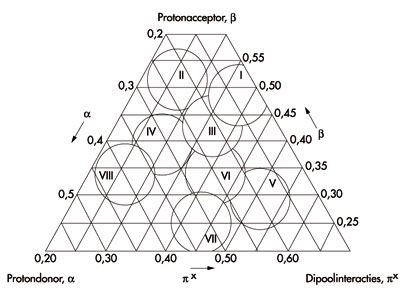
This solvent classification I to VIII resulting in different selectivity is shown below:
| I | Alifatic ethers, methyl t-buthyl ether, tetramethylguanidine, hexamethyl, fosforzuuramide (trialkylamines) | |
| II | Alifatic alcohols, methanol, | |
| III | Pyridinederivates, tetrahydrofuran, amides (except formamide), glycol ethers, sulfoxides | |
| IV | Glycols, benzylalcohol, acetic acid, formamide | |
| V | Ethylene chloride | |
| VI | a) Tricresylfosfate, alifatic ketons and esters, dioxane, polyesters | |
| b) Sulfones, nitriles, acetonitril, propylene carbonate | ||
| VII | Aromatische carbohydrates, toluene, halo-substituted aromatic carbohydrates, nitro-compounds, methylene chloride, aromatic ethers | |
| VIII | Fluoroalcohols, m-cresol, water, (chloroform) |
Although numerically different, each of these classification methods for liquids can be used to make semi-quantitative predictions about mobile phase selection and optimization.
Water, methanol, acetonitrile and tetrahydrofuran are the most commonly used solvents in RPLC and have a different elution strenght. In RPLC, for example, water has an elution strenght of almost zero while for tetrahydrofurane this value is significant larger.
A system to quantitatively compare the elution strenght of solvents is based on experimental observations from the relationships logarithm retention factor (ln k) of test components versus organic modifier percentage φ in mobile phases.
This figure shows for three test compounds naphthalene, anisol and phenol examples of such relationships ln k versus φ respectively with methanol, acetonitrile and tetrahydrofuran as the organic modifiers. The figure shows that the intercepts, slopes and linearities of curves are substantially different.
Retention vs fraction organic modifier (fenol on bottom)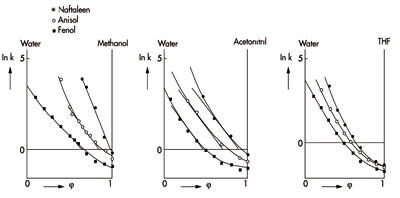
| I | Alifatic ethers, methyl t-buthyl ether, tetramethylguanidine, hexamethyl, fosforzuuramide (trialkylamines) | |
| II | Alifatic alcohols, methanol, | |
| III | Pyridinederivates, tetrahydrofuran, amides (except formamide), glycol ethers, sulfoxides | |
| IV | Glycols, benzylalcohol, acetic acid, formamide | |
| V | Ethylene chloride | |
| VI | a) Tricresylfosfate, alifatic ketons and esters, dioxane, polyesters | |
| b) Sulfones, nitriles, acetonitril, propylene carbonate | ||
| VII | Aromatische carbohydrates, toluene, halo-substituted aromatic carbohydrates, nitro-compounds, methylene chloride, aromatic ethers | |
| VIII | Fluoroalcohols, m-cresol, water, (chloroform) |
For a given combination component and separation system such relations generally follow the equation:
ln k + ln kw + aφ + bφ2
k = retention factor component
Kw = hypothetical retention factor component in pure water, obtained by extrapolation
φ = volume fraction organic modifier in mobile phase
a, b are constants, depending on component and separation system
In the area between 0.1> φ > 0.9 deviations from the formula may occur. As can be seen in the figure curves on a certain trajectory are linear. The size of this linear trajectory in first instance depends on the combination of component and nature of the modifier, and lies roughly in the region 0.1 < φ <0.8. This linear trajectory meets the simplified equation:
ln k = ln kw - Sφ
S = slope of the curve.
S-values strongly depend on the component and the nature of the modifier. By determining s- values for a large number of test components in different mobile phase compositions, for each modifier an average elution strenght Si can be calculated. The table shows for a number of solvents these Si values.
| Water | 0,0 | |
| Methanol | 2,6 | |
| Acetonitril | 3,2 | |
| Aceton | 3,4 | |
| Dioxaan | 3,5 | |
| Ethanol | 3,6 | |
| Isopropanol | 4,2 | |
| Tetrahydrofuraan | 4,5 |
These can be used to calculate so-called isoeluotrope mobile phase compositions. In case of similar elution strenghts and total analysis time, we use these data to add other modifiers to a mobile phase to improve the selectivity of a separation.
Example:
Let’s assume we have a ternary mobile phase consisting of the volume fractions 0.6 water, 0.3 methanol and 0.1 tetrahydrofuran. Now we want to replace the methanol fraction with acetonitrile while maintaining the same elution strenght of the mobile phase. What percentage acetonitrile should be added instead of 30% methanol? For the total elution strenght it holds:
ST = Σi Si φi
Si = elution strenghtof the modifier
φi = fraction of the corresponding modifier in the mobile phase
For the original mobile phase this gives:
ST = 0.6. 0.0 + 0.3. 2.6 + 0.1. 4.5 = 1.23
For the new mobile phase this leads to:
ST = 1.23 =φW + φa . 3.2 + 0.1. 4.5
here φw and φa are the volume fractions respectively of water and acetonitrile in the mobile phase.
This results into φa = 0.244. While maintaining a constant elution strenght the new mobile phase consists of the following volume fractions: 0.66 water, 0.24 acetonitrile and 0.10 tetrahydrofuran. For binary and quaternary mobile phases similar calculations apply.
This approach to maintain the strength of a mobile phase constant must be handled carefully. In a number of cases, calculation and experiment are not consistent. This since, apart from elution strenght, solvents may also contribute to the selectivity of a mobile phase.
Some general rules:
- The polar/ionic activity of RPLC phases and the dissociation / protonation of sample components are dominantly determined by the pH of the mobile phase.
- The actual pH of a mobile phase is highly dependent and changes with the nature and the amount of a specific modifier. This shift in the ph is to a lesser extent influenced by the nature of the buffer salts.
- The buffering capacity of mobile phases and pka values of sample components may significantly change with the nature and concentration of the organic modifier in a mobile phase.
The pH of the mobile phase is a dominant parameter in many RPLC separations. This applies especially for weak alkaline and acidic components, such as peptides, proteins, carboxylic acids, etcetera. This is because the dissociation and of protonation level of such compounds is determined by the actual pH of the mobile phase.
Also the actual physical-chemical state of an RPLC column is determined substantially by the pH of the mobile phase. This is in particular the case with silica-based RPLC- column materials.
In HPLC usually the pH of the aqueous part of the mobile phase is mentioned as the pH of the whole mobile phase. In other words, we assume that after adding an organic modifier to the buffered aqueous part of the mobile phase the pH remains unchanged.  This assumption is wrong in most cases.
In addition to the impact of the shift in pH caused by the addition of organic modifiers to mobile phases there are two other effects. Figure below illustrates that the addition of methanol to a phosphate buffer the buffering capacity of the mobile phase drastically decreases with increasing amounts of methanol.
The actual pH of mobile phase of buffers vs the experimental value.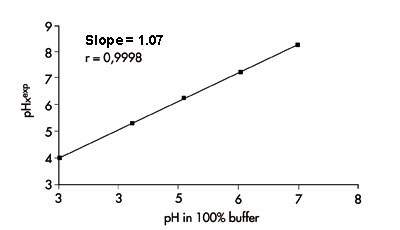
A second effect that may occur is the shift of the pKa values of the sample components after adding organic modifiers to aqueous buffers. This is illustrated below for the drug mirtazipine for the organic modifiers methanol, acetonitrile and tetrahydrofuran. The figure shows that after adding a few percent of an organic modifier the pKa value of this compound is reduced significantly. Also this case shows that the decline in pKa value is significantly bigger for tetrahydrofuran than for the two other modifiers.
% Methanol vs buffer capacity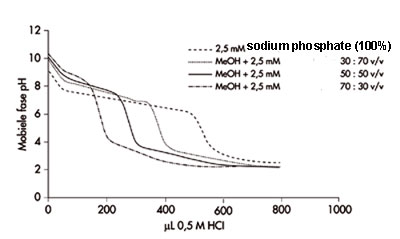
Nature and concentration of buffering salts have an influence:
- On column longevity in particular with silica-based RPLC phases, has been discussed (Link).
- May have a profound influence on retention and peak symmetry of sample components.
- The occurrence of these effects depends on the ph of the mobile phase and to a high degree on the polar / ionogenic nature of the sample components.
The actual physical chemical condition and activity of RPLC phases is influenced by the composition of the mobile phase.
- In other words, the characteristics of a stationary phase -which also determine retention and selectivity - do vary and change significantly with the mobile phase composition.
- Many RPLC phases and, in particular, silica-based stationary phases contain polar / ionic groups. These groups may play, except for the separation of apolar compounds, a key role in retention and selectivity.
- The actual activity of these polar/ionic groups together with the degree of solvation of the ligands substantially influences the retention and selectivity properties of rplc columns.
The pKa value of the dissociation equilibrium of silanol groups: Sioh <-> SiO- + H+ is approximately 7. In practice silica substrates and RPLC phases derived thereof however show large mutually differences in pKa values. This is reflected by the pH of suspensions of silica substrates in pure water.
In general, the dissociation of protons and the activity of polar / ionic sites on rplc phases are determined by the nature and concentration of these groups and also largely by the ph of the mobile phase.
To obtain reliable and repeatable analysis results it is necessary that RPLC columns under specific operational conditions show constant retention and selectivity properties.
To achieve that goal one of the necessary conditions is that the pH of the mobile phase and the nature and concentration of buffer salts therin must be constant. After all, this guarantees a specific and constant polar / ionic activity of for example silanol groups at the surface of RPLC phases. The following examples illustrate the great importance of a proper pH and buffering choice of the eluent in order to obtain reliable and reproducible analysis results. Therefore it is strongly recommended - except for apolair components – to buffer eluents properly on a specific pH.
- Example 1. In a and b eighteen RPLC columns were evaluated according to the standard of engelhardt under non-buffered and buffered (pH = 7) mobile phase conditions. The hydrofobicity and polar / ionic (silanol activity) properties of these columns were determined and are shown in x-y diagrams. Under the conditions of the original non-buffered engelhardt test each of the columns have a specific position in the hydrofobicity versus polar / ionic activity diagrams (a). Test results with the same test, however, under buffered ph = 7 mobile phase conditions shows a significant shift from the polar / ionic activity for virtually all columns. Also note that the silanol activity of the various columns under buffered mobile phase conditions are considerably more similar, compared with non-buffered mobile phase conditions. As can be seen also in a and b selfevidently the hydrophobicity properties of the columns do not change upon buffering and non-buffering of the mobile phase.
- Example 2. Fig a and b demonstrate the separation of a sample consisting of two neutral (and ethylbenzene and pentylbenzene) and a pair of ionic components (nortriptyline and amitryptiline) under non-buffered and buffered (ph = 7) conditions. As can be expected the peak positions and shape of ethyl- and pentyl benzene under both conditions are nearly identical.
Under non-buffered mobile phase conditions however (Example 1) the separation and peak symmetry of both the ionic components, however, is unacceptable and also poorly repeatable. In contrast for the buffered eluent the results for these basic analytes with respect to retention, selectivity and peak symmetry are substantially better with a rsd value of 0.1 - 0.3%.
Influence of modifier.
A second important factor with respect to the composition of eluent is the nature and concentration of the organic modifier(s) in the aqueous mobile phase. These parameters determine the solvation of the ligands at the stationary surface. Methanol, acetonitrile and tetrahydrofuran are the most important organic modifiers in RPLC. These modifiers are in varying degrees adsorbed to the ligands of RPLC - phases. Apart from the nature and concentration of the organic modifiers the degree of solvation or wetting of a RPLC phase depends also on the nature and length of the ligands. Methanol adsorbs the least, followed by acetonitrile while tetrahydrofuran adsorbs best for RPLC phases.
This adsorption of for example THF is preferential. In other words, the amount of adsorbed organic modifier is not linearly related to the concentration of modifier in the mobile phase. This is also true, albeit to different degrees, for the other two widely used modifiers, methanol and acetonitrile. The degree of preferential adsorption depends, apart from the fraction of organic modifier in the mobile phase, also on the nature and surface coverage of the ligands to the substrate. For RPLC-stationary phases with a strong ionic / polar activity of the substrate also preferential enrichment of water from the eluent to that may occur.
A minimum adsorption of an organic modifier onto an RPLC phase is of great importance for the solvatation (wettability, wetting) of the ligands in water / organic mobile phases. The organic ligands of most RPLC phases are not solvated in pure aqueous mobile phases. Adding a small amount for example a few percent of an organic modifier to the mobile phase, will by preferential adsorption create an intermediate solvatation layer on the ligands. In turn this allows the ligands to interact with the bulk composition of the mobile phase resulting in a repeatable retention and selectivity behaviour. Therfore, unless one uses specially suited columns in general it is strongly disencouraged to use RPLC columns in purely aqueous mobile phases.
Apart from binary eluents to optimize retention and selectivity in the RPLC, for a number of separations also ternary and quaternary mobile phases are used. The use of several different organic modifiers in a mobile phase may offer attractive possibilities to further improve the selectivity of a separation system. In the case of ternary and quaternary mobile phases, the preferential adsorption of the organic modifiers to the ligands becomes more complicated. As example, for a specific RPLC phase after the initial adsorption of about 18 mg of methanol per gram this is cancelled out at the level of approximately 10% tetrahydrofuran in the mobile phase.
This process, in which acetonitrile first exclusively was adsorbed to the column, after increasing the concentration of tetrahydrofuran develops entirely different. The number, nature and concentrations of organic modifiers in a mobile phase substantially influences the preferential adsorption and thus the solvatation of ligands in RPLC phases. This is well understandable considering the substantial differences in the physico-chemical properties of RPLC solvents. This may significantly influence the retention and selectivity properties of rplc columns.
In some cases, for example in ion pair RPLC or to suppress the ionic activity of a column, special additives are added to the mobile phases. The intended effects are often based on the adsorption of these additives to the polar / ionic active sites of the column these effects are not in all cases reversible. In other words, the characteristics of a RPLC column that has been used with a mobile phase containing such additives, may be changed permanently. It is recommended therfore to use such columns only for one specific separation.