Abstract Column choice is often neglected, mostly due to lack of time or lack of knowledge. It is generally considered too complicated and a non-optimal column is the result. This is a serious pitfall for lab efficiency, since a non-optimal column will lead to time loss, wrong results and mistakes. For column choice, there is no 'silver bullet', no simple answer. One needs to understand more about columns and test methods to make good choices. This investment will pay back. This hapter and related chapters in RPLC will help you.
The resolution, Rs, between any two peaks is an important descriptor of separation quality and is controlled by retention, selectivity and column efficiency. Thus, the resolution is adjusted by changing eluent strength, particle size, modifier type, and many other parameters. This chapter provides some practical guidelines for selection and optimization.
KeywordsColumn choice, Stationary phase, Molecular weight, Hydrophobicity, Ionization, Method optimization, Resolution (Rs), Retention, Selectivity, Efficiency, Reduced plate height, Modifier, Mobile phase, Analysis time, Temperature, Particle size, Column length, Ligand, Mobile phase velocity, Elution strength, Viscosity.
LevelBasic
In general the selection of a column is influenced by the desired:
- Column efficiency, selectivity and longevity
- Analysis time
- Sensitivity: narrower peaks allow lower detection limits
- Sample capacity: overloading the column results in poor peak shape
- Economic factors
- Instrumental parameters
After selecting the most suitable separation mode and a column, the resolution, sample capacity, speed, cost, reliability, limits of detection, etc. of the method are optimized. There are complex tradeoffs between each of these parameters.
This chapter gives some basics on column choice. In the RPLC topic we will provide more depth and detail on this subject.
Optimising the column and setting parameters is always a compromise and determined by:
- the separation power of the system
- the required speed of the analysis
- the sensitivity
- the sample capacity
- financial aspects
- the operational reliability
- environmental requirements
These requirements are interdependent: a system with maximum separation power is not the fastest nor does it have the highest sensitivity. When planning a method, the relative importance of the above considerations must be stated. The final choice will always be a compromise.
Optimization objectives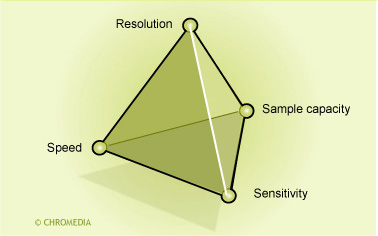
Once the choice of a suitable technique has been made, the operational system can be set up. Then we have to answer questions such as:
- What column length and diameter should we use?
- Which particle size?
- What should be the composition, the eluent strength and pH of the mobile phase?
- What are the concentrations of the compounds of interest?
HPLC can be classified into several sub-techniques like for example reversed and normal phase chromatography. And each of these techniques use their own specific types of columns, each with different column types. A proper technique and column must be selected based on the physical chemical properties of the analytes and the sample matrix. The main parameters are:
Molecular weight
The molecular weight is the first criterion.
- 2000 g/mol is the typical cutoff for most HPLC separation modes, although wide-pore RPLC phases can perform separations of peptides and small proteins up to 10,000 Daltons.
- Generally however Size Exclusion Chromatography (SEC) is the first choice for the analysis of samples of molecular weights larger than 2000.
Hydrophobicity
- The polarity of the sample analytes is an important criterion: whether the analytes are nonpolar, polar or ionic? Especially the choice of the stationary phase and the composition of the mobile phase are determined by the the physical chemical state of the analytes.
- The sample solvent or solubility of the matrix is another important factor in the selection of aseparation technique.
Ionization
The extent of ionisation of analytes depends amongst others on the pH of the sample solvent and more importantly of the pH of the eluent. This has a major effect on the chromatographic behaviour and also on the sample capacity of a column.
Column choice
The next step is the choice of the column. For the development and improvement of HPLC methods, the selection of the proper column is a crucial step. This is not at all an easy and straightforward task. In a column selection process several aspects must be considered like for example:
- Selectivity,
- Efficiency,
- Analysis time
- Column longevity
Local expertise, consulting the scientific/technical literature can be of substantial help in a column selection procedure. This chapter gives some practical guidelines and examples. In order to find - among the many available - the best column for a specific application a more systematic and objective column selection procedure must be used. In the RPLC Topic Circle several chapters go deeper into this subject.
At present analysis time has become an important issue in the development of separation methods. The practical analysis time is the actual analysis time plus the stabilisation time of the column before the next injection. The following parameters play a role in the analysis time:
- Column length: the analysis time increases proportional to the length of the column.
- The strength of the mobile phase: the more organic modifier, the higher the eluting power and the shorter the retention times.
- Chain length of the reversed phase material: a C4 phase produces less retention than C8 or C18 phases
- The linear velocity of the mobile phase: the higher the flow, the faster the analysis; presently technology allows column pressures up to 1000 bar.
- The particle size: the H-u curve allows small particles to be operated at a higher mobile phase velocity. This offers the possibility of higher speed analysis without losing too much efficiency and separation.
- Temperature: increasing the column temperature substantially decreases the eluent viscosity , resulting in much shorter analysis times.
The resolution formula can serve as guidance for the optimization: 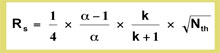
Separation / Resolution Rs
The separation of two components is expressed as the resolution and is determined by three parameters:
- The retention factors of components in the chromatographic system (k)
- The system selectivity: the ratio of retention factors (alpha)
- The peak width; column efficiency, Nth
These parameters influence the separation. The effect can be seen in the simulation:
The retention is operationally coupled to the strength of both the mobile phase, the nature of the stationary phase and other experimental conditions:
- The column chemistry, more particularly the ligand chain length
- Surface coverage
- The composition and the pH of the eluent
- The column temperature
The retention factor k is determined by the column, the eluent composition, the temperature and is a thermodynamic magnitude. In practice retention factors:
- Are best adjusted in between 2 < k < 10.
- Smaller retention factor values may result in poor separations.
- Large k-values do not improve the resolution. Moreover they result in too long analysis times and poor detectability of the
 analytes.
Effect of retention on resolution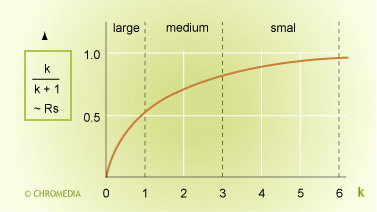 The retention term in the resolution equation approaches an asymptote of 1 at high k: with a k = 10 this contribution to the separation is 10/11, or ~ 1.
Which parameter in the separation hereunder must be optimized? Is it a retention problem? Is the efficiency inadequate? Is the system not sufficiently selective, or is it a combination of factors?
- If the k-value is too small, it is a retention problem.
- If the plate number is far below the expected number, it is an efficiency problem.
- If k and Nth are correct, the separation is probably not selective enough.
With some experience, this conclusion can be made by visual inspection of the chromatogram. Some typical examples follow here and in the next paragraphs.
Optimization: a retention factor problem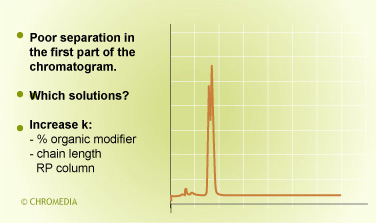
Selectivity is calculated from the ratio of retention factors of adjacent peaks and this thermodymodynamic parameter is determined by the column nature, the eluent composition and the temperature.
Resolution as function of selectivity and efficiency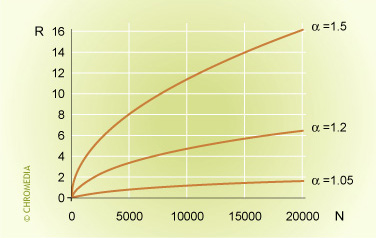 As can be seen in the figure above the selectivity substantially influences the resolution of a chromatographic system. Selectivity in HPLC is not always easily to understand or to predict. This is due to the fact that this selectivity parameter is determined by the physical chemical properties of the stationary and mobile phases and also by the temperature. Compared to GC in HPLC plate numbers are limited.
The quality of chromatographic columns can be expressed in the number of plates N; the plate height H or the reduced plate height h . The relationship between the latter two magnitudes H, h and the particle size of a packing material is:
h = H / dp
For well packed columns typical h-values in between 2 - 3 are found.
- For a column with a length of 10 cm and a particle size of 5 µm, our rule of thumb indicates that the maximum achievable plate number N is approximately 10,000.
- For a 3 µm particle size the maximum efficiency increases to 15,000 plates.
The resolution equation shows that the effect of the plate number on the separation is limited since its effect is proportional to the  square root of Nth.
The selectivity of a separation is determined by:
- the composition of the mobile phase; nature and percentage of
 modifier(s); nature and concentration of buffering salts ; actual eluent pH and other additives.
 - the chemistry of the stationary phase; ligand chain length and bonding; surface coverage; residual polar activity
- column temperature
If the peaks to be separated are too close to the un-retained component, a substantial change in the strength of the mobile phase will give a better result. If the peaks to be separated are sufficiently retained and they are "nicely" shaped, selectivity is the keyword. The system selectivity must be optimized by changing columns or by changing the mobile phase, e.g. comparing selectivity of iso-eluotropic mobile phases.
An example:
Optimization: a selectivity problem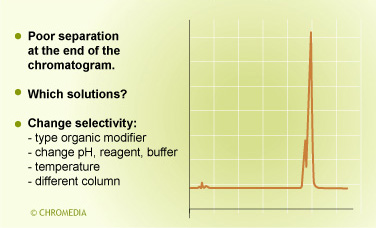
If the column plate number is decreasing, replacement of the column may become necessary. This efficiency loss is often be caused by contamination and or detoriation of the column. An instable baseline and increasing column backpressure are indicative for that. In some cases by regeneration with a strong solvent the column can temporarily restored.
Optimization: An efficiency problem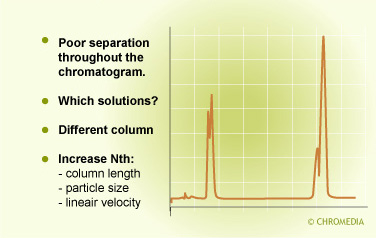 If the number of plates is too small to achieve a targeted separation, the following steps can be considered:
- use longer columns. Longer columns provides higher plate number proportionally to its lenght
- reduction of the particle size of the packing
- optimize column temperature , nature of the modifier and eluent velocity
As discussed in the RPLC-section, a 10% reduction in the percentage modifier in the mobile phase on an average result in a doubling of the retention factors of the peaks. The general equation for the resolution tells us that this will increase the separation for components eluting early in the chromatogram. Decreasing the % modifier has little or no effect on the selectivity of the system.
Effect of modifier percentage on retention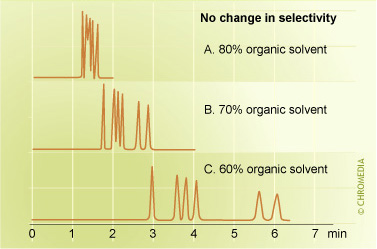
In the binary mixture methanol – water some peaks in the first part of the chromatogram are not separated.
Type of modifier & selectivity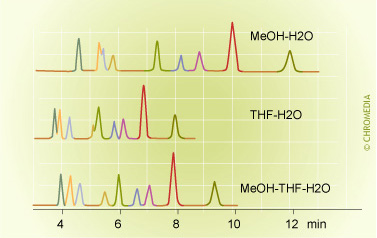 Using iso-eluotropic rules, other modifiers can be explored. In this case, the THF-water mixture obviously results in a different selectivity with some peaks poorly separated.
The ternary MeOH – THF – H2O mixture is able to produce the required selectivity for separation of all the components. Unfortunately, these differences are not easy to predict. The optimum mobile phase composition must often be found by trial-and-error. Optimization software can be a helpful tool in this process.
Column optimization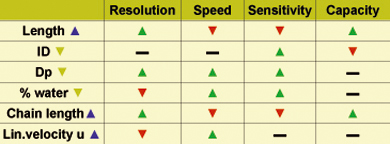 Chromatographic separation problems can be solved in many ways. The table above summarizes the effects of increasing or decreasing various parameters. For instance, increasing column length increases resolution, but decreases analytical speed.
If the peaks to be separated are too close to the un-retained component, a substantial change in the strength of the mobile phase will give a better result. If the peaks to be separated are sufficiently retained and they are "nicely" shaped,  selectivity is the keyword. The system selectivity must be optimized by changing columns or by changing the mobile phase, e.g. comparing selectivity of iso-eluotropic mobile phases.