Abstract In HPLC column dimensions are important in many regards. The interplay between column length, particle diameter and separation quality determines factors such as run time, solvent consumption and peak height. Recently, decreased particle size has flattened van Deemter curves and allowed the development of short, efficient, high-speed columns. The effects of the column parameters e.g. length, particle size on a separation, analysis time and detection limits are described in a compact manner.
KeywordsPlate number (N), Column length, , Wall effect, Radial diffusion, Infinite column, High-speed column, UPLC, Sensitivity, Dilution factor, Injection volume, Retention factor, Peak broadening, Peak volume, van Deemter equation.
LevelBasic
The column dimensions have a strong effect on the separation. As an example, increasing the column length (L) results in:
- higher Nth
- longer analysis time
- increased pressure
- larger retention time
While smaller particle size (dp) results in:
- higher Nth
- shorter analysis time
- high pressure drop
The table summarizes the effects of increasing or decreasing various parameters. For instance, increasing column length increases resolution, but decreases analytical speed.
Column optimization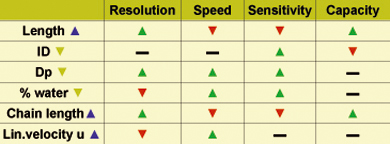
Mobile phase
Apart from these parameters, there are physico-chemical parameters resulting from the interaction of the stationary phase with the mobile phase that must be taken into account. If we observe that the peaks to be separated are too close to the un-retained component, a substantial change in the strength of the mobile phase will give a better result. If the peaks to be separated are sufficiently retained and they are "nicely" shaped,  selectivity is the keyword. The system selectivity must be optimized by changing columns or by changing the mobile phase, e.g. comparing selectivities of iso-eluotropic mobile phases. These subjects will be discussed in other chapters of columns and in the RPLC topic.
Short columns are attractive for the reduction of the analysis time. The plate number is reduced proportionally with the length, but the resolution only decreases by a factor of the square root of N, so resolution would decrease by the square root of L. By using short columns filled with small particles, the loss in efficiency can be compensated and fast separations can be obtained. Short lengths in brief have:
- Advantages:
- Fast analyses
- Higher sensitivity
- Reduced operational costs
- Disadvantages:
- Lower efficiency
- reduced peak capacity (separation)
- Reduced sample capacity
Increasing the column length
Doubling the column length results in:
- doubled retention times
- doubled plate number
- doubled pressure drop across the column
- increase in resolution by a factor of 1.44 (i.e. √2)
- no change in retention factors (k)
Increasing length causes a linear lengthening of the analysis time, as we can  see in the next example:
Example of influence of column length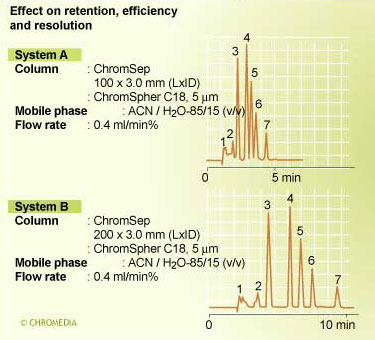
Infinite columns
Columns with diameter/length ratios that are sufficiently high so as to eliminate wall losses, are called 'infinite' columns. Ideally, 100 x 3.0 mm ID or 150 x 4.6 mm ID columns can be considered infinite. That is, they behave "infinitely" with a point injection. With a normal injection, poor packing quality near the wall, or a poor wall structure, this 'infinite' effect is not achieved; the plate number is no longer linearly proportional to the length in such a case.
Small particle packing in HPLC columns is beneficial for both the separation and the analysis time. All modern HPLC systems can handle columns packed with 2, 3 or 5 micron particles. Columns packed with small stationary phase particles generate significantly higher back pressures. Modern HPLC instrumentation more and more is designed to handle such high back pressures up to 1000 bars.
The particle size alone has no direct effect on the analysis time. However, columns with smaller particles produce a higher efficiency at higher mobile phase velocity (as seen by the locations of the relative minima in the van Deemter equation). Therefore, a better separation can be obtained in a shorter time.
- Advantages:
- large efficiency
- high optimal flow
- Disadvantages:
- high pressure
- increased risk on column clogging
Smaller particles produce a higher column efficiency, regardless of the mobile phase velocity since the H-u curve of small particles is below the H-u curve of larger particles. This fact can be used to shorten the analysis time, as in the illustration below. If a separation has been optimized but the run time is unacceptable, smaller particles can operate at increasing mobile phase velocity and decreasing tr's. Effect particle size on retention and resolution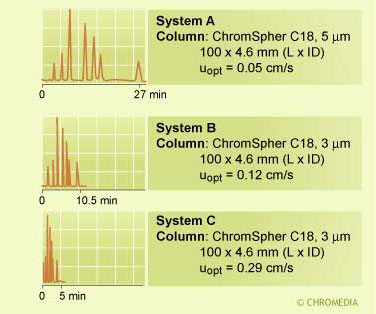
Effect on analysis time
The effect of particle size on analysis time is less obvious. In theory, particle size has no direct effect on the analysis time. Yet in practice, the smaller particles will always allow shorter run times. When the mobile phase velocity is increased above the optimum, some  loss in efficiency and resolution is observed, but this effect is much smaller than the improvement in analysis time. As a result, HPLC columns are always used at higher than optimal mobile phase velocities.
Problems with small particles
Small particles can cause some problems in practice. The most important drawback is the increased risk of clogging the top of the column or the column frits. An LC column is usually fitted with frits to hold particles in place. 3 µm particles require frits with pores of 0.5 µm. Smaller particles require smaller frits. This causes plugging problems with solvents and samples.
|
dp (µm)
L (mm) ID (mm) |
5
100 4.6 | 3 50 4.6 | 1.5 30 4.6 |
| Nth | 6000 | 6000 | 6000 |
| pressure (MPa) | 4.5 | 6.2 | 15 |
| t0 (min) | 1.2 | 0.5 | 0.2 |
| tr (min) | 14 | 6 | 2.5 |
| ml solvent per analysis | 14 | 6 | 2.5 |
At constant column efficiency and comparing particle sizes of 10 and 2 µm the analysis time can be reduced by a factor of about 6 by using smaller particles at higher flow rates. The pressure drop, however, will be 4 times higher, which may decrease the column longevity. At present, special systems have been introduced with relatively short (e.g. 5 cm) columns packed with 2 µm particles (or smaller). With this so-called Fast HPLC or UPLC technology, very fast separations can be achieved.
Short columns filled with small packing particles provide good efficiency and short analysis times. These high-speed columns are between 3 and 10 cm in length, are packed with small particles (3 µm or smaller) and operate at high mobile phase velocities. The increased eluent velocity reduces the analysis time considerably. As a consequence, the productivity of a single analyst on a given piece of equipment increases. This will result in a larger laboratory sample throughput and a lower cost per analysis. High-speed columns:
- Use small particles
- Are short
- Operate at high velocity
Their advantages include:
- Good efficiency
- Very fast analysis
- Reduced operational costs
Some examples of the effect of smaller length and smaller particles
Column dimensions, analysis time and sensitivity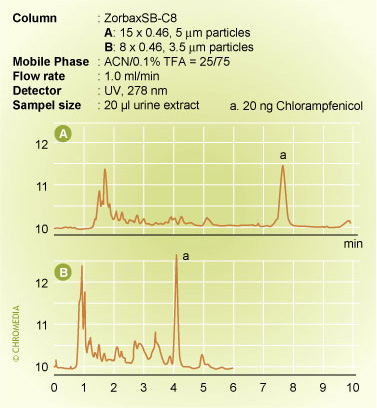 Snyder and KirklandFor the above analysis of a urine extract, two different columns with approximately equal plate number are used (Both drawn on the same time-scale, 10 minutes max). Notice that the column length of B is reduced from 15 to 8 cm and the particle size in B is decreased (5 to 3.5 µm). The analysis time is reduced by the decreased column length. In both runs 20 µl of urine extract is injected. The increased peak height for chloramphenicol on column B is the result of the smaller dilution factor. The net result is in favour of method B: a comparable separation, shorter analysis time, reduced solvent consumption per analysis and higher sensitivity of the method with the same equipment.
Example number 2:
High-speed LC (3 micrometer)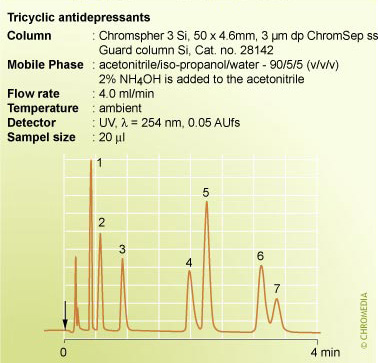 In the above chromatogram, a normal phase column packed with 3 micron particles is used at a flow rate of 4 ml/min. Because of the low viscosity of this eluent and the short column, the pressure drop remains acceptable. Under these conditions the sample components are separated in less than 4 minutes.
High-speed LC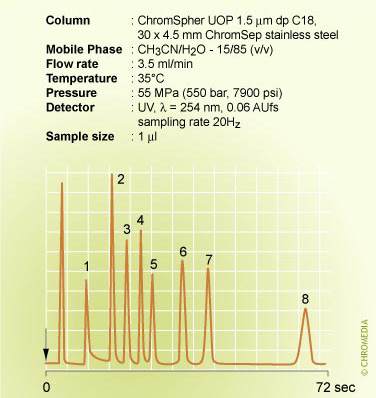 Decreasing the particle size down to 1.5 micron (non porous particles in this example) allows a further reduction in the column length to 3 cm and separation takes place in less than 70 seconds! This however, is at the expense of considerably higher column backpressure which may cause problems after extended use and injections of real samples. More on this in the Fast LC Topic Circle.
H-u curves for ultra small particles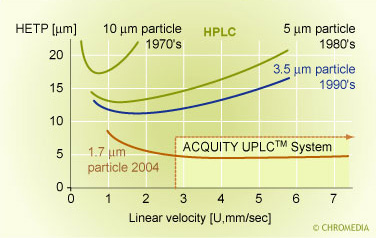 Source: Waters Corp.The last 30 years small particles were developed that made acceptable resolution possible at higher speeds. (These days, more systems are available other than ACQUITY with very small particle sizes that permit Fast LC.)
Plate number and backpressure as function of particle size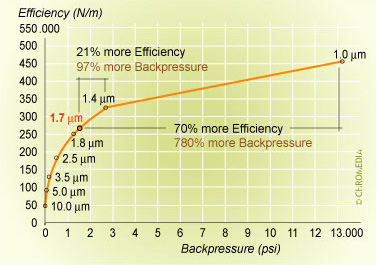 Efficiency increases, but backpressure is much higher with smaller particles.
The majority of analytical HPLC columns used currently have internal diameters between 2 and 5 mm. In theory, the column diameter does not affect the plate number. At decreased column inner diameter, however, extra-column broadening becomes significant and the analyst must pay close attention to instrument design and assembly. In brief, a small internal diameter has:
- Advantages:
- Improved sensitivity
- Reduced solvent consumption
- Disadvantages:
- Reduced system and column efficiency
- More demanding system requirements
- Small sample capacity
For small volumes of sample, narrow bore columns should be used. Dilution in these columns is much smaller, resulting in larger chromatographic peaks. This can substantially reduce the detection limits of the method.
Example of the effect of different column diameters
For the comparison of 4 different columns hereunder, the flow rate is adjusted by the square of their internal diameters of (4.6 – 3.9 – 3.0 – 2.1 mm) in order to keep mobile phase velocities the same. The same chromatogram on the smaller bore column, however, requires less solvent. The increase in peak heights seen in the figure is the direct result of the reduced dilution in the columns. In all cases, a 7 µl sample was injected.
Separation & sensitivity vs column diameter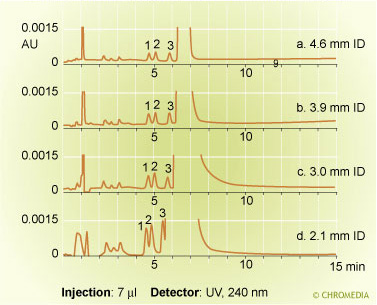 Uwe Neue in HPLC Columns, 1997. © WILEY-VCH, Inc. The smaller columns in this example seem to be more sensitive. However, it might be just as easy to inject a much larger volume on the 4.6 or 3.0 mm columns, which would result in bigger peaks. This is, of course, only possible if sufficient sample is available.
This conclusion that smaller columns are more sensitive needs to be qualified a bit. First, the increase in sensitivity obtained with a small I.D. column may be cancelled out if the column dimensions limit the sample injection size. In other words, the maximum permitted injection volume is related to the column volume. This volume overloading is probably the reason for the reduced resolution between peaks 1 and 2 on the 2.1 mm ID column. Note that the offscale peak is also broadened by concentration overloading on the minibore column.
As a final note, reduced column flow is also desirable for certain detectors (in electrochemistry and LC/MS with electrospray ionisation).
The column dilutes the sample and therefore affects the sensitivity of the entire method. HPLC columns dilute the sample components with mobile phase during the elution process, an important consideration if using a concentration-sensitive detector. By the way, we often think of sensitivity only as a property of the detector whose noise and response factors give rise to a certain detection limit. We must realise that method sensitivity results from more parameters.
Effect of dilution
The extent of dilution is expressed by the dilution factor (DF), the ratio of the component concentration in the injected sample to the component concentration at the column's end. It appears that this dilution is determined by:
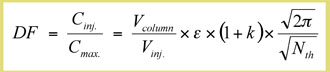
where e is column porosity (around 0.65 for silica based columns), k is retention factor and Nth is the number of theoretical plates.
The column parameters in this equation affect the dilution, and thus the peak height produced by a concentration dependent detector (e.g. a UV detector) as follows:
- The column volume. The larger the column volume, the more mobile phase is needed to 'flush' the sample through the column. Dilution will be substantial with a large column volume. Keep in mind that the elution volume is proportional to column length and the square of column diameter. Since the dilution only takes place in the mobile phase, the
 column volume must be corrected for the porosity (e-term).
 - The injection volume. Dilution is proportional to the ratio of the column volume to the injection volume. A larger injection volume will be diluted less in the same column volume.
- The plate number. Little sample dispersion occurs in a highly efficient column. Since peak width is measured as either a time or a volume, narrower peaks imply that the sample remains dissolved in a smaller volume. The dilution is inversely proportional to the square root of the plate number N.
- The retention factors (k-values). The peak width of components with large k-values is always larger than that of less retained components. As was explained in plate number, narrower peaks mean a higher concentration of analyte in the mobile phase.
In the example below, a 20 µl sample is  analysed with 3 different columns containing the same packing material. The differences in analysis time are related to the length of the columns. The reduced flow rate of the first column is the result of the smaller column diameter (3.0 mm) and highlights the primary advantage of small bore columns. The observed differences in peak heights are directly related to the different dilution factors of these 3 columns. Effect of column dimension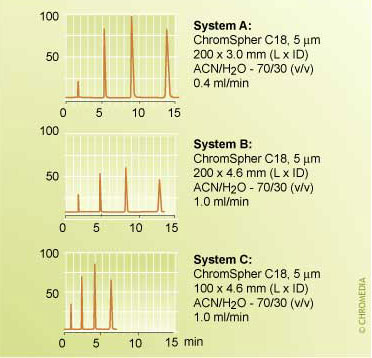
| System A: 200 x 3.0 mm | System B: 200 x 4.6 mm | System C: 100 x 4.6 mm | |
| V column (µl) | 1400 | 3320 | 1660 |
| V injection (µl) | 20 | 20 | 20 |
| Nth | 15100 | 15500 | 8600 |
| DF | 7.5 | 16.5 | 11.0 |
| Peak height (PH) | 13.0 | 6.0 | 9.2 |
| DF x PH | 98 | 99 | 101 |
Smaller dilution gives higher peaks. As predicted by theory, the product of the dilution factor DF and the peak heights of the columns is constant.
Of course this is only true as long as the same sample volume is used to compare the columns.
On smaller columns the advantageous effect of decreased dilution is lost by a reduction of the injection volume. The maximum volume that can be injected depends on the column volume, which in turn is proportional to the square of the column diameter. In order to preserve resolution, the smallest possible quantity of sample is injected onto the column.
- For conventional 4.6 mm ID columns, sample volumes of 5 to 20 microliters are usually applied.
- For smaller ID columns or non-porous or pellicular phases the maximum injection volumes are much smaller- on the order of 0.1 to 3 microliters.
- If the injection volume is kept constant, the dilution and sensitivity are only affected by the column geometry and efficiency.