Abstract For a given column dead time and given two solvents, a binary linear gradient is fully described by the gradient range, the gradient slope and a possible initial isocratic hold. These conditions should be well chosen in order to have a good compromise between analysis time and quality of separation.
LevelBasic
In gradient elution, the composition of the mobile phase is changed during the elution according to a pre-set program. A binary linear gradient elution is the simplest type. In this case, the variation of the mobile phase composition as a function of the time can be expressed by
In gradient elution, the composition of the mobile phase is changed during the elution according to a pre-set program. A binary linear gradient elution is the simplest type. In this case, the variation of the mobile phase composition as a function of the time can be expressed by
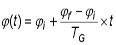
Where  φi and φf are the initial and final compositions, respectively, and tG is the gradient time.
(φf-φI) represents the gradient range and (φf -φi )/tG is the gradient slope, i.e. the rate at which the strong solvent concentration varies with time.
In addition to the three parameters, φi, φf and tG, the gradient method may also include an initial isocratic hold. It must be pointed out that this initial isocratic hold does not correspond to the total delay time which always includes the  dwell time. The effect of the dwell time on the separation is discussed in more detail in the chapter on gradient transfer.
- All four parameters have a significant effect on the three major criteria required for a good analysis, namely the analysis time, the relative retention between the peaks and the signal to noise ratio.
- Isocratic elution is unsatisfactory regardless of the mobile phase composition. In case of a weak eluent, the analysis time is dramatically high and the peak height very low for the most retained compounds. Conversely, a strong eluent leads to a loss of separation for the less retained compounds.
- When increasing the gradient time while keeping other parameters constant, the retention times increase and the signal height decreases.
- A strong starting eluent spoils the separation of the less retained compounds while a weak eluent provides a good separation in the first part of the chromatogram but may require excessive analysis time.
- A strong final composition incurs a useless additional time. On the other hand, the more retained compounds might not elute from the column or elute under isocratic conditions if the final composition is too weak.
Non linear or multi linear gradients can be used but both are more difficult to handle and their conditions more complex to optimize. A third solvent may be sometimes necessary to adjust the selectivity. The development of such ternary gradients is also much more complex.
The effect of flow-rate on column efficiency is of course the same in gradient and isocratic methods. In contrast the effect of flow-rate on retention times and selectivity is quite different.
In a gradient method, highly retained components stay unmoved at the very top of the column while the mobile phase remains weak, but elute quickly as soon as the solvent strength is sufficient. This situation will not change when increasing the flow-rate while keeping the gradient time constant and consequently the effect of a flow-rate modification on the retention time is not the same for all compounds. This situation is quite different from isocratic elution.
In isocratic methods, there is a "retention volume" that is a characteristic of a solute with a given chromatographic system. It is expressed by
Vr = V0 (1+k)
where V0 is the column dead volume and k, the retention factor. This latter is not affected by varying the flow-rate and as a result neither the retention volumes nor the selectivity will change. All solute retention times will change in proportion to the column dead time.
The gradient retention volume can be expressed by a similar expression:
Vr = V0 (1+kg)
where kg is usually called the apparent gradient retention factor. kg is on the one hand dependent on gradient parameters and on the other hand dependent on the flow-rate too. As a result, both retention volume and selectivity will change with the flow-rate. The solute retention times will not change in proportion to the column dead time. It can be shown that the flow-rate have the same effect on kg and therefore on selectivity than the gradient time. The extent to which the selectivity is affected depends on the solute nature, as it can be seen on the proceeding figure by changing the gradient time.
When the analysis time in an isocratic elution is longer than 10 x t0, a gradient run is probably beneficial. In RPLC, by running a scouting gradient, it is possible, for a given sample, to rapidly determine if a gradient elution is required. This experiment has to be performed with either water-acetonitrile or water-methanol mobile phases and with the following conditions:- φI = 5%
- φf = 95%
- TG = 18 x t0
The difference in the elution compositions of the first and last eluted peaks serves as a good rule of thumb: if the difference is greater than 30%, a gradient method is beneficial. If the difference is less than 30%, an isocratic elution is feasible.
An example is given in the Figure below
Scouting for the choice of the elution mode, isocratic or gradient:
In this case a gradient is required (Click to enlarge)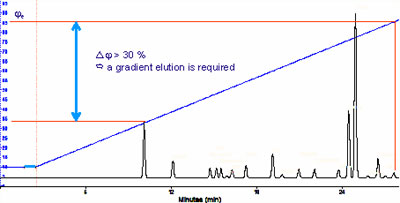
In this case a gradient is feasable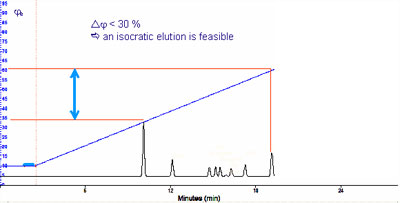 In addition to useful information on the required elution mode, this experiment allows a rough estimation of the number of components in the sample.
In case of a simple linear gradient, two parameters have a significant effect on the quality of the separation: the initial composition and the gradient slope. The final composition may be adjusted according to the elution composition of the last eluted solute, the elution composition, φe being given by

Optimizing the initial composition and the gradient slope is sometimes complex and may require the use of computing tools.
Some basic rules should be applied to develop a linear gradient method in RP-HPLC:
- Start with a first gradient trial 5% to 95% acetonitrile or methanol with a gradient slope equal to 5/t0 (%/min). This first experiment indicates whether a gradient elution is required or not as explained above.
- Keep in mind that the dwell time provides an additional isocratic stage at the beginning of the gradient.
- Adjust the gradient slope within the range 1/t0 to 10/t0 (%/min). When the gradient slope is too high, the quality of the separation may be bad. In contrast, when it is too low, the analysis time is significant and the peak heights are low.
- In considering the full duration of a gradient analysis, one must also consider the time required to reequilibrate the column prior to injecting the next sample. RPLC columns typically require 5 to 10 x t0 for reequilibration.
The table below gives some examples of gradient slopes according to various column characteristics.
| Column dimensions | V0 (mL) | Flow-rate (mL/min) | t0 (min) | Best gradient slope (%/min) | tG (min) for a first trial (5-100%) |
| 250 x 4.6 mm, 5µm | 2.9 | 1 | 2.9 | 0.35 to 3.5 | 52 |
| 150 x 4.6 mm, 5µm | 1.7 | 1 | 1.7 | 0.6 to 6 | 31 |
| 100 x 3 mm, 3µm | 0.5 | 0.7 | 0.7 | 1.4 to 14 | 13 |
| 50 x 2.1 mm, 1.7 µm | 0.12 | 0.6 | 0.2 | 5 to 50 | 3.6 |